
Software teams often miss deadlines, underestimate work, find defects too late, or struggle because responsibilities are unclear. Team Software Process was created to solve those exact problems through better planning, team roles, measurement, and quality control.
If you are asking “what is team software process,” the simple answer is this: Team Software Process, or TSP, is a structured software engineering method that helps teams plan their work, track progress, measure quality, and improve how they build software.
This guide explains what TSP means, how it works, when it helps, where it becomes too heavy, and which alternatives may fit better for modern software teams.
Quick Verdict
Best for: Software teams that need stronger planning, better estimates, clearer roles, and earlier defect control.
Not ideal for: Small casual projects, very fast-moving teams, or teams that only need a simple task board.
Main benefit: TSP helps teams move from guesswork to measured software engineering.
Main concern: It can become heavy or ineffective if the team lacks training, trust, and management support.
Better alternative if relevant: Scrum or Kanban may be better when the team wants a lighter workflow method.
Why Team Software Process Is Often Misunderstood
TSP is often explained badly because people compare it directly with Agile, Scrum, or project management tools. That creates confusion.
TSP is not Jira. It is not Trello. It is not Scrum. It is also not just a checklist for software managers.
TSP is a disciplined engineering process. Its main focus is not only “getting tasks done.” Its deeper purpose is to help software teams make realistic plans, take ownership of their commitments, measure actual work, find defects earlier, and improve the way they build software over time.
That difference matters. If your team only needs a visual workflow, TSP may be too much. If your team keeps failing because estimates are weak and quality problems appear late, TSP becomes more relevant.
What Is Team Software Process?
Team Software Process is a structured software engineering framework developed by Watts S. Humphrey at the Software Engineering Institute at Carnegie Mellon University.
It guides software engineering teams in building software-intensive products through planning, team roles, quality management, measurement, tracking, and process improvement.
In practical terms, TSP helps a team answer important questions before and during development:
- What exactly are we building?
- What work must be done?
- Who owns each part of the work?
- How much effort will it take?
- How will we know if the plan is realistic?
- Where are defects likely to appear?
- How will we improve after this cycle?
TSP is closely connected to PSP, which means Personal Software Process. PSP focuses on the individual engineer’s planning, estimating, defect tracking, and personal improvement. TSP applies similar discipline at the team level.
So, PSP improves the individual engineer’s process. TSP improves the team’s process.
A Simple Practical Example
Imagine a 10-member software team building a payment module for a business application.
Before using TSP, the team may work like this: the manager sets a deadline, developers estimate quickly, testing starts late, bugs appear near release, and everyone blames “unexpected complexity.”
With TSP, the team works differently. They begin with a launch meeting. They break the project into tasks, define roles, estimate effort, identify risks, plan reviews, set quality goals, and track actual progress against the original plan.
If the team estimated 300 hours but reaches 180 hours with only 40% of the work complete, the problem becomes visible early. The team can adjust the plan before the deadline collapses.
That is the real value of TSP. It does not magically make software easier. It makes planning, quality, and progress more visible.
How We Reviewed This Topic
This is a source-based review, not a hands-on implementation review.
The article is based on official and credible public information, including Software Engineering Institute material on TSP and PSP, Google Search Central guidance on helpful content, the official Scrum Guide, Kanban references, and CMMI information.
No hands-on TSP implementation was performed for this article. Because TSP is a process framework rather than a downloadable software application, this article does not claim personal testing, ratings, user reviews, performance benchmarks, app permissions, or pricing experience.
Where official sources do not clearly mention pricing, privacy policy, regional availability, or modern implementation details, this article states that clearly instead of guessing.
Key Confirmed Parts of Team Software Process
Because TSP is not a software application, its “features” are better understood as process elements.
Team Planning
TSP helps teams create their own development plans. The team estimates work, defines tasks, reviews risks, and makes commitments based on the actual engineering work required.
Defined Team Roles
TSP encourages clear ownership inside the team. Roles may cover planning, quality, process tracking, support, development coordination, or management communication.
The goal is simple: important work should not be invisible or ownerless.
Launch Process
A TSP launch is a structured starting point where the team builds its plan. This may include goals, role assignments, strategy, estimates, quality planning, risk review, and management communication.
The launch is one of the most important parts of TSP because it turns vague expectations into an engineering plan.
Process Measurement
TSP uses measurement to compare planned work with actual work. Teams may track effort, schedule progress, defects, reviews, and quality indicators.
This helps teams improve based on evidence rather than opinions.
Quality Management
TSP puts strong focus on finding and preventing defects earlier. Instead of depending only on final testing, the process encourages reviews, inspections, defect tracking, and quality planning during development.
Connection With PSP
TSP works best when team members understand PSP principles. PSP helps individual engineers measure and improve their own work, while TSP coordinates team-level planning and performance.
Relaunch and Improvement
Software projects change. TSP supports relaunches or replanning when new information appears, project scope changes, or the team enters a new phase.
This makes the process more realistic than a one-time project plan that nobody updates.
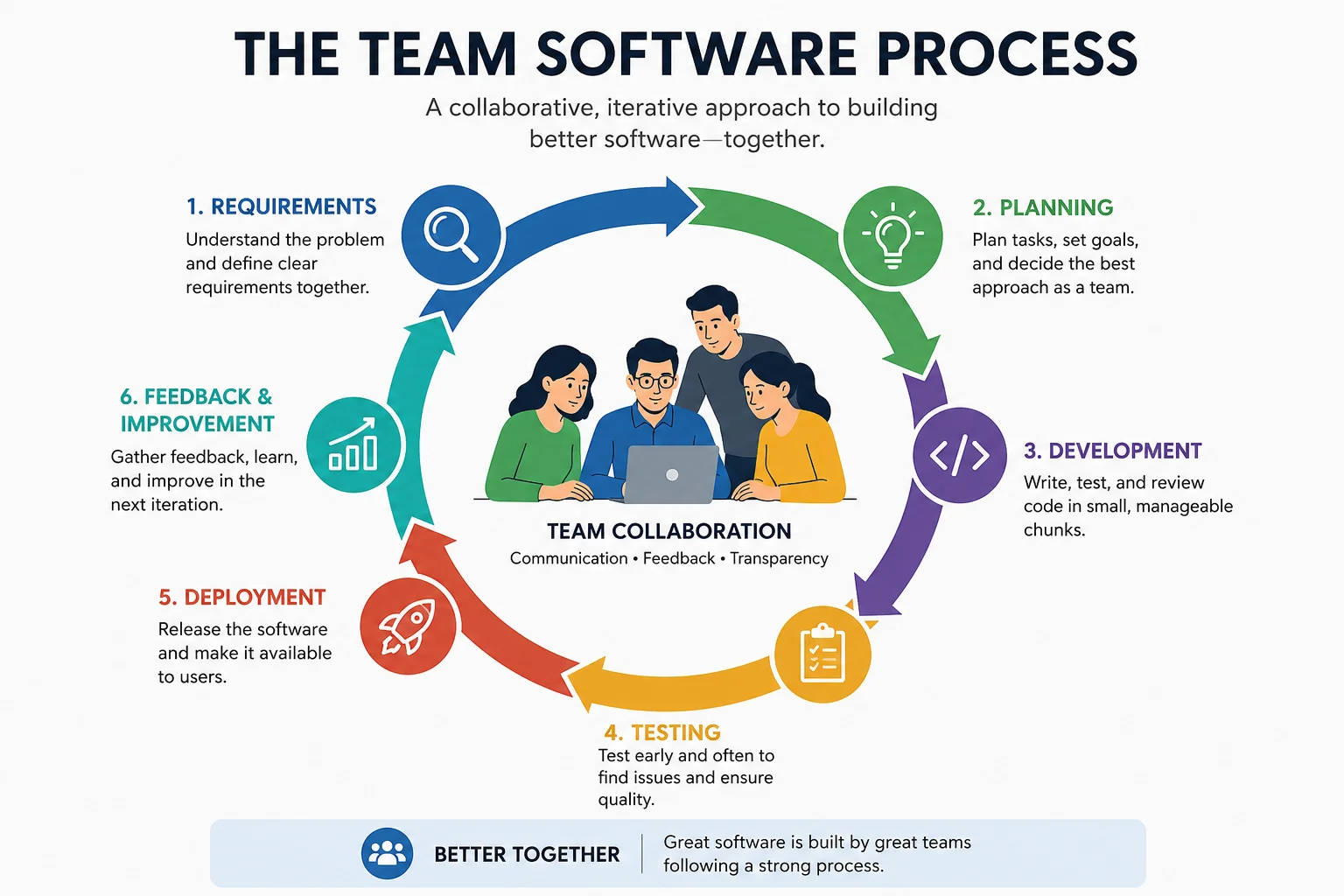
How Team Software Process Works
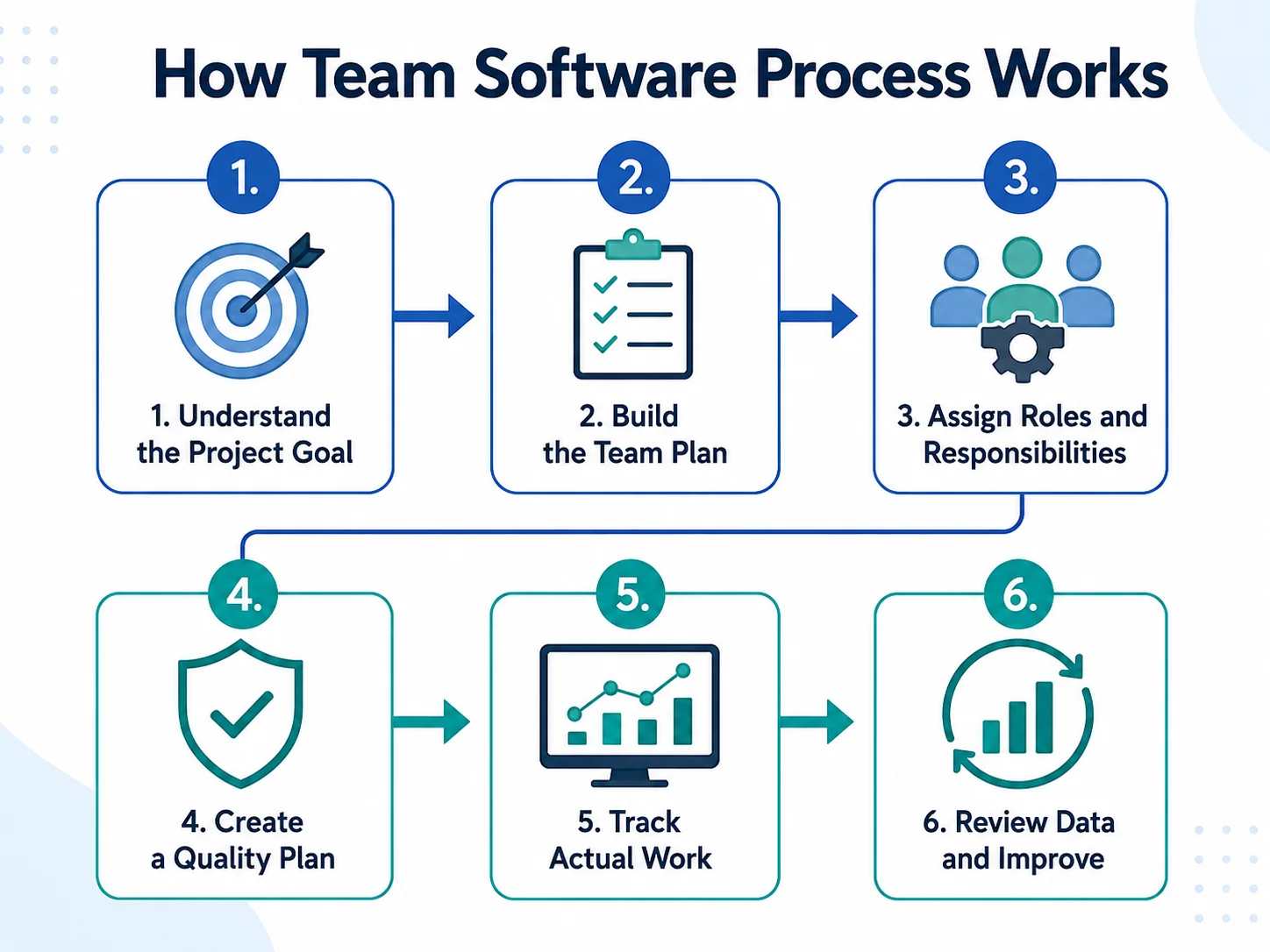
Step 1: Understand the Project Goal
The team must first understand what the product or software component needs to achieve. Without a clear goal, planning becomes guesswork.
This includes understanding scope, requirements, constraints, expected quality level, risks, and delivery expectations.
Step 2: Build the Team Plan
The team breaks the work into tasks and estimates the effort required. Unlike top-down planning, TSP expects the team to participate in creating the plan.
This matters because developers often understand technical complexity better than managers who are farther from the code.
Step 3: Assign Roles and Responsibilities
The team defines who is responsible for different parts of the process. This may include development tasks, quality tracking, planning, support, process data, and reporting.
Clear roles reduce confusion and make accountability easier.
Step 4: Create a Quality Plan
TSP does not treat quality as something that happens only at the end. The team plans how defects will be prevented, found, reviewed, and tracked.
This may include peer reviews, inspections, design checks, code reviews, testing plans, and defect analysis.
Step 5: Track Actual Work
As the project continues, the team tracks actual effort, progress, defects, and schedule status. This allows the team to compare reality with the original plan.
If the plan is wrong, the team can adjust before the project becomes unrecoverable.
Step 6: Review Data and Improve
After a cycle or phase, the team reviews what happened. They look at estimation accuracy, defects, missed risks, schedule performance, and process problems.
The goal is not to blame people. The goal is to improve the process.
Pricing or Availability
TSP is not sold like a normal software product.
Official SEI pages provide reports, educational material references, training material references, TSP/PSP resources, and launch-related material. However, a simple public pricing page for buying “Team Software Process” as a single product was not clearly found in the official sources reviewed.
Pricing: Not clearly mentioned by the official source.
Availability: TSP material is available through public SEI resources, reports, and educational references. Training or guided implementation may depend on available courses, organizational arrangements, or SEI-related resources.
Platform: TSP is process-based, not app-based.
Free, paid, or freemium: Not clearly mentioned by the official source as a single packaged product.
Region limits: Not clearly mentioned by the official source.
Safety, Privacy, and Team Data Concerns
Because TSP is a process framework, normal app-based privacy issues such as logins, cloud storage, permissions, and third-party data sharing do not directly apply.
The real privacy concern is different: team metrics.
TSP may involve collecting data about effort, estimates, defects, reviews, and progress. This information can help a team improve, but it can also be misused if management treats it as a weapon.
A healthy TSP implementation should use data to improve the process, not to shame developers.
For example, if one developer reports more defects because they are being honest and another developer hides defects to look better, the data becomes useless. That is why trust is essential.
Organizations using TSP should clearly define:
- Who can see individual and team metrics
- How defect data will be used
- Whether metrics affect performance reviews
- How project data will be stored
- How team members can challenge incorrect data
- Whether reporting is for improvement or punishment
If those rules are unclear, TSP can damage trust instead of improving quality.
Pros and Cons
Pros
TSP helps teams create more realistic software plans.
It improves visibility into effort, schedule, quality, and defects.
It gives teams clearer roles and ownership.
It encourages early defect prevention instead of late panic testing.
It supports continuous improvement based on real data.
It can help engineering teams make stronger commitments because the team participates in planning.
It is useful for complex software projects where quality and predictability matter.
Cons
TSP can feel heavy for small or low-risk projects.
It requires training and process discipline.
It may not fit teams that prefer very lightweight Agile workflows.
It can become paperwork if leaders do not understand the purpose.
It can damage team trust if metrics are used for blame.
It is less commonly discussed today than Scrum, Kanban, or Agile.
It may require cultural change before it produces real value.
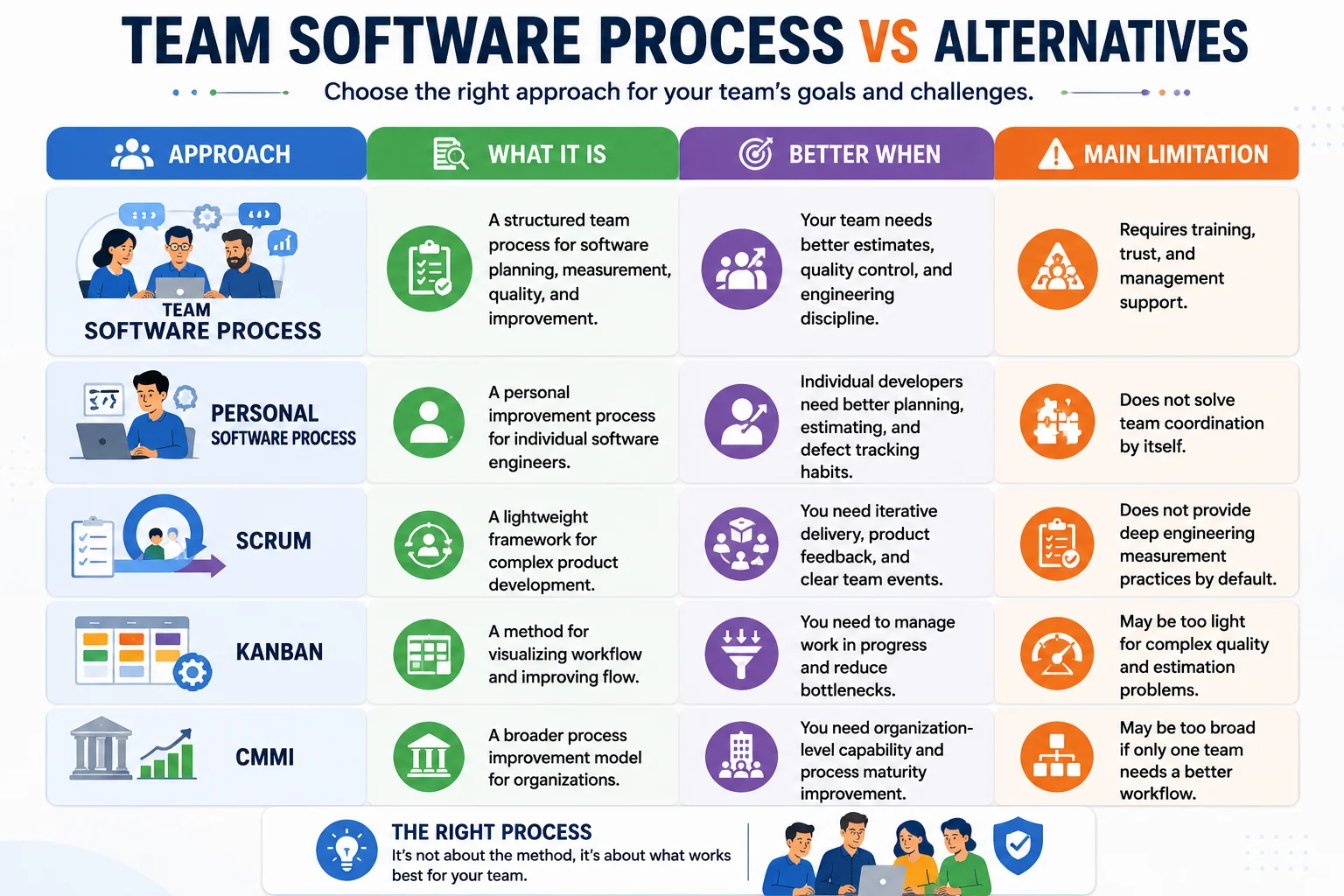
Team Software Process vs Alternatives
| Approach | What It Is | Better When | Main Limitation |
| Team Software Process | A structured team process for software planning, measurement, quality, and improvement | Your team needs better estimates, quality control, and engineering discipline | Requires training, trust, and management support |
| Personal Software Process | A personal improvement process for individual software engineers | Individual developers need better planning, estimating, and defect tracking habits | Does not solve team coordination by itself |
| Scrum | A lightweight framework for complex product development | You need iterative delivery, product feedback, and clear team events | Does not provide deep engineering measurement practices by default |
| Kanban | A method for visualizing workflow and improving flow | You need to manage work in progress and reduce bottlenecks | May be too light for complex quality and estimation problems |
| CMMI | A broader process improvement model for organizations | You need organization-level capability and process maturity improvement | May be too broad if only one team needs a better workflow |
Best Alternatives to Team Software Process
Scrum
Scrum is a better choice when the team wants a lightweight framework for iterative product development. It gives teams clear accountabilities, events, artifacts, and a structure for regular inspection and adaptation.
Scrum may be better than TSP when the main problem is product delivery rhythm rather than engineering measurement.
Kanban
Kanban is better when the team wants to visualize work, reduce bottlenecks, and improve flow without introducing a heavy process.
It is often easier to start because teams can apply Kanban to their current workflow instead of redesigning everything at once.
Personal Software Process
PSP is better when individual engineers need to improve personal estimation, planning, and defect management.
It is especially useful when the team’s problems begin with weak individual work tracking or poor personal estimation habits.
CMMI
CMMI is better when the organization wants broader process improvement across teams or departments.
It may be useful for companies that need organization-level capability improvement rather than a process for one development team.
Agile With Selected TSP Practices
Many modern teams may not need full TSP. A practical option is to use Scrum or Kanban for workflow and add selected TSP-style practices.
For example, a team can use Kanban for daily work, then add TSP-inspired estimation reviews, defect tracking, quality planning, and post-cycle analysis.
This hybrid approach may be easier for teams that already use Agile but need better engineering discipline.
Who Should Use the Team Software Process?
TSP is useful for software teams that build complex, serious, or quality-sensitive systems.
It is a strong fit when the team has problems such as missed deadlines, poor estimates, late defects, weak ownership, unclear responsibilities, or repeated project surprises.
It is also useful when management wants more predictable delivery but is willing to let the engineering team create realistic plans.
TSP is more likely to work when the team has training, trust, and enough discipline to collect honest process data.
Who Should Avoid Team Software Process?
Avoid TSP if your project is small, temporary, or low-risk.
Avoid it if your team only needs a simple visual task board.
Avoid it if leadership wants to use metrics mainly to pressure developers.
Avoid it if your team has no time for training or process discipline.
Avoid it if your company culture punishes people for reporting problems honestly.
Avoid it if the team already works well with Scrum or Kanban and has no serious estimation or quality problem.
TSP is powerful only when the team is mature enough to use measurement honestly.
Practical Tips Before Adopting TSP
Start with the actual problem. Do not adopt TSP just because it sounds formal. Use it only if your team genuinely needs better planning, quality control, or process improvement.
Introduce it gradually. A team may benefit from TSP-style launch planning, role clarity, and defect tracking without adopting every practice immediately.
Protect team metrics. Make it clear that data exists to improve the process, not punish individuals.
Train the team first. Without basic understanding of PSP and process measurement, TSP can turn into empty documentation.
Keep the process useful. If a report, metric, or meeting does not help the team make better decisions, simplify it.
Combine carefully with Agile. Scrum or Kanban can manage workflow, while TSP practices can improve estimation and quality. But forcing too many systems at once can overload the team.
Review after every cycle. The team should regularly ask what worked, what failed, and what should change next time.
Final Verdict
Team Software Process is not for every software team. It is too structured for small projects that only need a simple workflow.
But for teams struggling with poor estimates, unclear ownership, late defects, and repeated missed commitments, TSP is worth understanding.
The strongest value of TSP is that it forces the team to plan honestly, measure real work, and improve based on evidence. The biggest risk is misuse. If managers use TSP metrics to blame developers, the process will fail.
For many modern teams, the best approach is not full TSP adoption. A better starting point may be Scrum or Kanban combined with selected TSP practices such as launch planning, quality reviews, defect tracking, and process improvement.
Use TSP when engineering discipline matters more than speed theater.
FAQs
What is Team Software Process?
- Team Software Process is a structured software engineering process that helps teams plan, track, measure, and improve software development work.
Is Team Software Process the same as Agile?
- No. TSP and Agile are not the same. Agile is a broad set of values and principles, while TSP is a disciplined process focused on planning, measurement, quality, and team improvement.
What is the difference between TSP and PSP?
- PSP focuses on individual software engineers. TSP focuses on the whole team. PSP improves personal planning and quality habits, while TSP applies similar discipline to team software development.
Is TSP a software tool?
- No. TSP is not an app, platform, or project management tool. It is a process framework for software engineering teams.
Is Team Software Process still useful?
- Yes, its ideas are still useful for teams that need better estimation, quality control, defect tracking, and planning discipline. However, many teams may use selected TSP practices instead of adopting the full process.
Is Scrum better than TSP?
- Scrum is better for lightweight iterative product development. TSP is better when the team needs deeper engineering discipline, quality measurement, and estimation improvement. The better choice depends on the team’s actual problem.
Does Team Software Process have pricing?
- Pricing is not clearly mentioned by the official source as a single product or subscription. TSP is a process framework with official reports, educational references, and training-related materials.

Charles Brook writes about business software, accounting tools, audit systems, and digital compliance for Vantiro Media. His guides help Kenyan SMEs, retailers, freelancers, and consultants compare accounting software, understand eTIMS-related requirements, and choose practical tools for daily business finance management.