
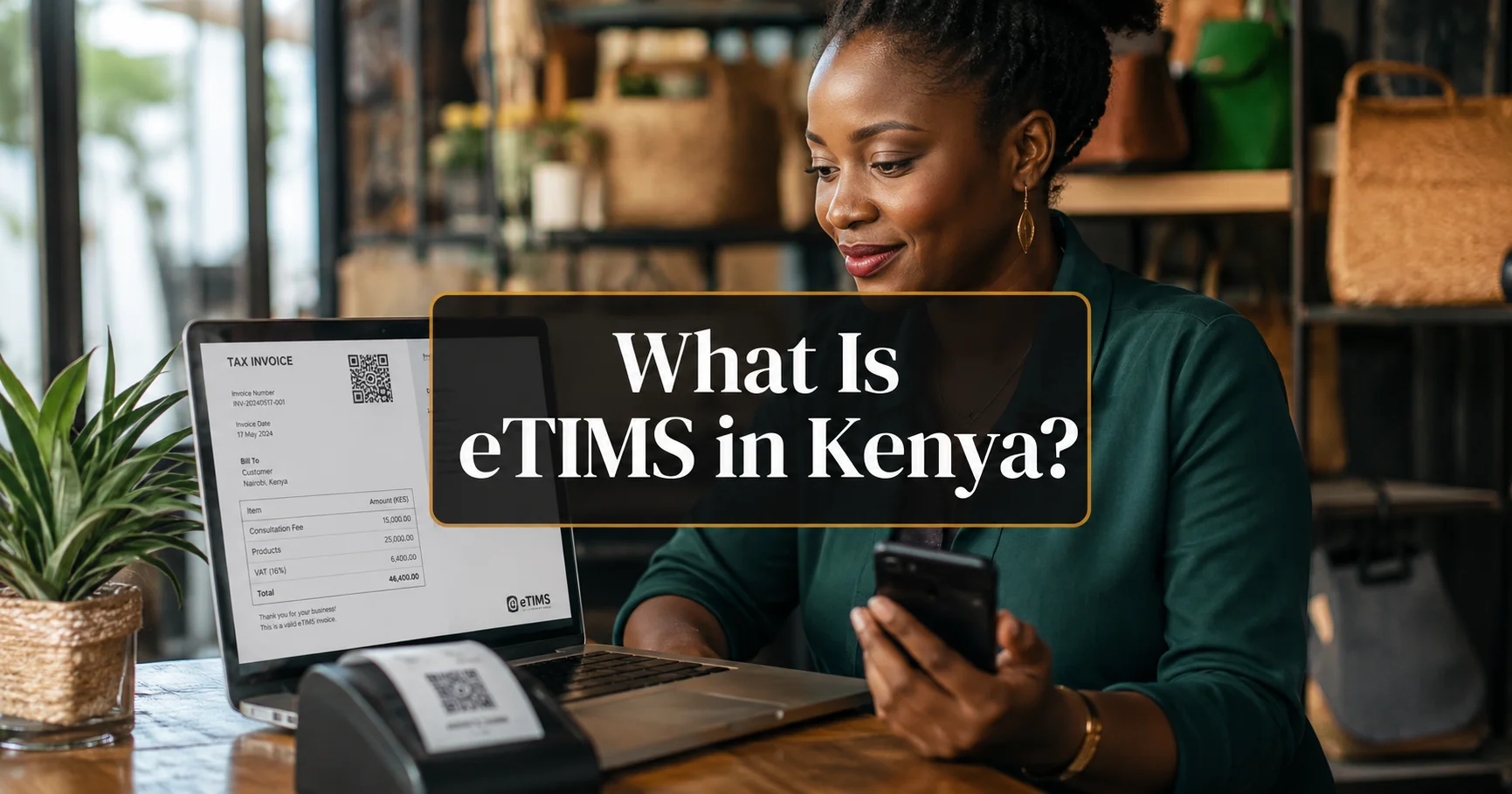
What Is eTIMS in Kenya? eTIMS is the Kenya Revenue Authority’s electronic tax invoicing system. Businesses use it to generate and transmit electronic tax invoices to KRA. It helps taxpayers keep proper invoice records, verify transactions, and comply with Kenya’s tax invoicing requirements.
eTIMS stands for Electronic Tax Invoice Management System. In simple words, it helps businesses move from manual or informal invoicing to digital tax invoices that can be tracked and verified.
If you run a business in Kenya, eTIMS is not something you should ignore. It affects how you issue invoices, record sales, support expenses, and stay compliant with KRA.
This guide explains What Is eTIMS in Kenya? in simple language for small businesses, freelancers, consultants, traders, companies, suppliers, and non-VAT registered businesses.
Disclaimer: This article is for general information only. Tax rules can change. Always confirm your specific situation with KRA or a qualified tax professional.
What Is eTIMS in Kenya?
What Is eTIMS in Kenya? It is a software-based electronic tax invoice management system used to create and transmit tax invoices digitally.
Instead of using only handwritten receipts, Excel invoices, or normal printed bills, businesses can issue electronic tax invoices through eTIMS. These invoices are easier to verify and easier to match with business records.
For a business owner, eTIMS mainly helps with:
- Creating electronic tax invoices
- Recording business sales
- Supporting KRA tax compliance
- Helping buyers verify invoices
- Improving business expense documentation
It is not only for big companies. Small businesses, freelancers, and some non-VAT registered taxpayers may also need to use eTIMS.
Is eTIMS Mandatory in Kenya?
Yes, businesses carrying on business in Kenya should take eTIMS seriously. KRA requires persons engaged in business to onboard eTIMS and issue electronic tax invoices.
A common mistake is thinking eTIMS is only for VAT-registered businesses. That is not safe. Non-VAT registered businesses may also be required to generate and transmit invoices electronically.
This means eTIMS can apply to:
- VAT-registered businesses
- Non-VAT registered businesses
- Sole proprietors
- Companies
- Partnerships
- Service providers
- Traders
- Small businesses
- Suppliers working with corporate buyers
If your business issues invoices or receives business income, you should check your eTIMS obligation instead of assuming you are exempt.
Why eTIMS Matters for Kenyan Businesses
eTIMS matters because Kenya is moving toward more transparent digital tax reporting. KRA wants business invoices to be properly recorded, transmitted, and verifiable.
For businesses, this has a direct impact. If you sell goods or services, your customers may ask for a valid eTIMS invoice. If you buy goods or services, you may need a valid electronic tax invoice to support your business expenses.
For example, if a company buys office supplies from a small supplier, the company may need a valid electronic tax invoice for expense records. If the supplier cannot issue one, the buyer may face problems when claiming that expense.
So, eTIMS is not just a tax system. It affects daily invoicing, bookkeeping, supplier relationships, and business compliance.
If you are also comparing tools for better bookkeeping and compliance, you can read our guide on common accounting and audit software used in Kenya.
How eTIMS Works
eTIMS works by allowing a business to generate invoices through an approved electronic invoicing solution. Once the invoice is created, invoice details are transmitted electronically to KRA.
A typical eTIMS invoice may include:
- Seller name
- Seller KRA PIN
- Buyer details where required
- Invoice number
- Invoice date
- Goods or services sold
- Amount charged
- Tax details where applicable
- QR code or verification details
The buyer can then verify the invoice using the available verification method. This makes the invoice more reliable than a normal paper invoice.
eTIMS vs TIMS: What Is the Difference?
Many Kenyan taxpayers confuse TIMS and eTIMS. They are related, but they are not exactly the same.
| TIMS | eTIMS |
| Earlier Tax Invoice Management System | Newer electronic Tax Invoice Management System |
| Often associated with physical devices | More software-based and flexible |
| Less convenient for some small businesses | Easier access through web, mobile, portal, and integrations |
| More device-focused | More digital and accessible |
| Limited flexibility | Better suited for different business sizes |
In simple terms, eTIMS is the more flexible software-based approach. It gives taxpayers more ways to issue electronic tax invoices.
Main eTIMS Options in Kenya
Different businesses need different eTIMS solutions. A freelancer does not need the same setup as a supermarket or a company with many branches.
| eTIMS Option | Best For | Main Benefit |
| eTIMS Lite Web | Small businesses and service providers | Simple browser-based invoicing |
| eTIMS Lite Mobile App | Small traders and mobile users | Convenient phone-based invoicing |
| eTIMS Lite USSD | Users without smartphones or with basic phones | Simple access through mobile code |
| eTIMS Online Portal | Service-based businesses | Easy online invoice creation |
| eTIMS Client | Businesses selling goods or goods and services | Useful for branches and pay points |
| VSCU / OSCU Integration | Larger businesses using ERP or accounting systems | Connects business systems with KRA |
| Buyer-Initiated Invoicing | Buyers dealing with small suppliers | Allows buyer to generate invoice where applicable |
Which eTIMS Option Should You Choose?
The best eTIMS option depends on your business size, invoice volume, and daily operations.
| Business Type | Suitable eTIMS Option |
| Freelancer or consultant | eTIMS Lite Web or Online Portal |
| Small retail shop | eTIMS Lite Mobile App or eTIMS Client |
| Business with several branches | eTIMS Client |
| Company using accounting software | VSCU / OSCU integration |
| High-volume retailer | Integrated solution |
| Buyer dealing with small suppliers | Buyer-initiated invoicing where applicable |
Do not choose a complicated system if your business only issues a few invoices per month. But do not use a basic option if you run a high-volume business with multiple sales points.
Practical Examples of eTIMS Use
Example 1: Freelancer
A freelance graphic designer in Nairobi sends invoices to clients every month. Instead of sending only a Word or PDF invoice, the freelancer can use eTIMS to generate an electronic tax invoice.
Example 2: Small Shop
A small shop selling household goods may use eTIMS Lite or another suitable option to issue electronic invoices and keep cleaner sales records.
Example 3: Service Provider
A cleaning company offering services to offices may need to issue valid eTIMS invoices because corporate clients often require proper documentation.
Example 4: Business Using Accounting Software
A larger business using ERP or accounting software may use system-to-system integration so invoice data can move smoothly between the business system and KRA.
Step-by-Step Guide: How to Get Started With eTIMS
1. Confirm Your KRA PIN and Business Details
Start by checking that your KRA PIN, business name, phone number, email address, and tax obligations are correct.
2. Understand Your Business Type
Before choosing a solution, ask yourself:
- Do I sell goods, services, or both?
- Do I issue many invoices daily or only a few monthly?
- Do I have one location or many branches?
- Do I already use accounting software?
- Do my customers request tax invoices?
These answers will help you choose the right eTIMS option.
3. Choose the Right eTIMS Solution
A consultant may only need the online portal or eTIMS Lite. A business with several branches may need eTIMS Client. A company with accounting software may need integration.
4. Register Through the Official Channel
Use official KRA guidance, the eTIMS platform, or the eCitizen invoicing option. Avoid random third-party links unless you are sure they are approved and legitimate.
5. Set Up Your Invoice Details
Depending on your solution, you may need to add:
- Products
- Services
- Branches
- Users
- Pay points
- Buyer details
- Tax settings
6. Start Issuing Electronic Tax Invoices
Once your setup is complete, start issuing invoices through eTIMS. Do not continue relying only on manual receipts if your business is required to issue electronic tax invoices.
7. Keep Proper Business Records
eTIMS helps with invoicing, but it does not replace bookkeeping. You still need to track your purchases, expenses, bank records, payroll, and tax filings.
Benefits of eTIMS for Businesses in Kenya
eTIMS can feel like extra work at first, but it can help serious businesses stay organized.
Key benefits include:
- Better KRA compliance
- Cleaner invoice records
- Easier invoice verification
- Reduced manual paperwork
- Stronger business expense support
- Better audit preparation
- More professional invoicing
For businesses that want to work with larger companies, valid electronic invoicing can also improve trust. Many corporate buyers prefer suppliers who can issue proper tax invoices.
Pros and Cons of eTIMS
| Pros | Cons |
| Helps businesses stay compliant | Setup may confuse beginners |
| Supports digital tax invoices | Staff may need training |
| Improves sales records | Internet or system issues may delay invoicing |
| Helps buyers verify invoices | Some integrations may cost money |
| Reduces informal invoicing | Poor bookkeeping can still cause tax problems |
Common eTIMS Mistakes to Avoid
Many businesses struggle with eTIMS because they delay setup or misunderstand the requirement.
Avoid these mistakes:
- Assuming eTIMS is only for VAT-registered businesses
- Waiting until tax filing season to fix invoice records
- Using manual receipts when electronic invoices are required
- Choosing an eTIMS option that does not match your business
- Not training staff who issue invoices
- Ignoring supplier invoice validity
- Treating eTIMS as a full accounting system
- Ignoring official KRA updates
eTIMS vs Traditional Invoicing
| Feature | Traditional Invoice | eTIMS Invoice |
| Format | Manual, printed, or PDF | Electronic tax invoice |
| Verification | Harder to verify | Easier to verify |
| KRA transmission | Limited or manual | Electronic transmission |
| Record quality | Depends on business records | More structured |
| Expense support | May be questioned | Stronger if valid |
| Compliance value | Weaker | Stronger |
A traditional invoice may look professional, but that does not automatically make it valid for tax compliance. For business tax records, the invoice needs to follow the correct electronic invoicing requirements.
Who Should Pay Close Attention to eTIMS?
You should pay close attention to eTIMS if:
- You run a business in Kenya
- You issue invoices to customers
- You sell to companies or institutions
- You claim business expenses
- You buy goods or services from suppliers
- You are a non-VAT business earning business income
- You want cleaner accounting records
If you ignore eTIMS, the problem may not appear immediately. It usually appears when filing taxes, claiming expenses, dealing with buyers, or responding to KRA compliance checks.
Final Verdict
So, What Is eTIMS in Kenya? It is Kenya’s electronic Tax Invoice Management System used to generate and transmit tax invoices digitally.
For business owners, the smartest move is to treat eTIMS as part of normal invoicing, not as a last-minute tax problem. Choose the right eTIMS option, issue valid electronic invoices, and keep proper accounting records alongside it.
The bottom line is simple: if you carry on business in Kenya, do not ignore eTIMS. Understand it early, set it up correctly, and use it consistently.
FAQs
1. What does eTIMS mean in Kenya?
eTIMS means Electronic Tax Invoice Management System. It is used for electronic tax invoicing and invoice transmission in Kenya.
2. Is eTIMS mandatory in Kenya?
Yes, persons carrying on business in Kenya may be required to onboard eTIMS and issue electronic tax invoices. Always confirm your exact obligation with KRA.
3. Is eTIMS only for VAT-registered businesses?
No. Non-VAT registered businesses may also need to use eTIMS if they are carrying on business.
4. Is eTIMS free to use?
KRA provides eTIMS options for taxpayers. However, businesses using third-party software or custom integrations may face provider-related costs.
5. Can small businesses use eTIMS?
Yes. Small businesses can use simpler options such as eTIMS Lite Web, mobile app, USSD, or online portal depending on their needs.
6. What is the difference between TIMS and eTIMS?
TIMS was more device-focused, while eTIMS is more software-based and flexible. eTIMS can be accessed through options such as web, mobile, portal, and system integration.
7. Why is an eTIMS invoice important?
An eTIMS invoice helps prove that a business transaction was electronically recorded. It supports tax compliance, invoice verification, and proper business expense documentation.

Charles Brook is the Founder of Vantiro Media and a University of Nairobi (B.Com) graduate. As a business software specialist, he helps Kenyan SMEs navigate eTIMS compliance, compare tools like QuickBooks, Zoho, & Sage, and choose the best budget-friendly accounting systems.
Kenya SME Software Brief
Need Help Choosing Accounting Software in Kenya?
Get simple buying tips, eTIMS guidance, VAT record advice, pricing comparisons, and software recommendations for Kenyan SMEs.
- eTIMS tips
- VAT records
- Pricing guides
- Software comparisons
No spam. Just useful Kenya business software updates and simple accounting guides.
Free Checklist