
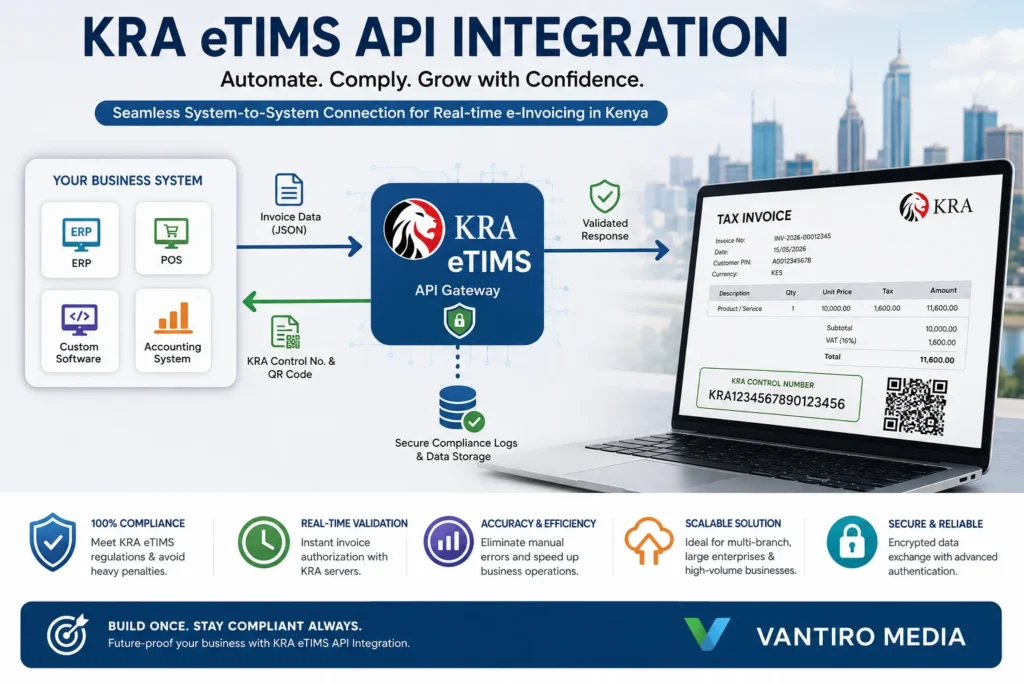
For large-scale businesses, multi-branch supermarkets, manufacturing hubs, and enterprises running custom in-house software in Kenya, manual invoice data entry is an operational impossibility. When your business processes hundreds or thousands of transactions daily, logging onto the basic eTIMS taxpayer portal or using mobile apps manually creates massive delays and room for human error.
Here at Vantiro Media, we understand that scaling a modern business requires automated tax compliance. This is where the kra etims integration api becomes a critical business requirement. It provides a direct “system-to-system” communication bridge that connects your native enterprise resource planning (ERP) system, point of sale (POS) terminal, or specialized billing software directly with the Kenya Revenue Authority (KRA) servers.
This guide breaks down how the eTIMS API integration works, its core technical requirements, and how to structure your implementation to comply with KRA’s strict 2026 enforcement rules.
1. What is KRA eTIMS System to System Integration?
(If you or your team are completely new to this tax framework, we highly recommend reading our foundational guide on what is eTIMS in Kenya first, before diving into these API technicalities.)
An etims system to system integration refers to automated, real-time data exchange between your private business software and the KRA eTIMS platform using application programming interfaces (APIs).
When a cashier or accountant generates an invoice inside an ERP system (such as SAP, Oracle, Odoo, or a proprietary custom framework) and clicks “Save,” a background process instantly triggers. The system formats the invoice data into a JSON payload and transmits it securely via an API endpoint to KRA. KRA’s server validates the parameters, stamps it with a unique digital signature, and sends a response back within milliseconds. Your system receives this approval and prints a fully compliant invoice featuring the official KRA Control Number and a scannable QR code.
2. Technical Architecture: OSCU vs VSCU
Before your development team writes a single line of code, you must select the correct implementation architecture based on your business environment. KRA provides two primary control unit models for API connections:
- OSCU (Online Sales Control Unit): Designed for businesses with a permanent, high-speed internet connection, such as cloud-hosted SaaS platforms or modern e-commerce sites. The API processes data sequentially and requires live connectivity to authorize transactions.
- VSCU (Virtual Sales Control Unit): Best suited for businesses with massive bulk transactions or remote physical branches where internet connectivity fluctuates. The VSCU architecture caches payloads locally on an encrypted background service and syncing data with KRA servers via batch API requests as soon as internet drops are restored.
3. Why Automated API Integration is Urgent in 2026
KRA has significantly upgraded its automated matching frameworks. Relying on standalone, non-integrated software now exposes large enterprises to immense regulatory and financial vulnerabilities:
Strict Automated Invoice Validation
Under the latest etims validation rules 2026, KRA automatically cross-references corporate income tax filings directly against real-time eTIMS data streams. If a custom ERP submits an invoice payload containing formatting bugs—such as mismatched buyer PINs, inaccurate global Harmonized System (HS) product codes, or incorrect tax classification mappings (16%, 8%, Exempt, or Zero-Rated)—the transaction is instantly flagged. An invalid invoice means your business clients cannot deduct that purchase as a tax expense, directly damaging your corporate partnerships.
Avoidance of Catastrophic Fines
Failing to integrate your primary invoicing tools properly is no longer treated as a simple administrative mistake. According to current kra etims penalties kenya regulations, businesses caught issuing non-validated or parallel manual invoices risk facing statutory fines equivalent to double the tax avoided, or a strict minimum penalty of Ksh 1 Million per non-compliant instance. A secure API pipeline eliminates this human risk completely.
4. Step-by-Step API Implementation Roadmap
For engineering and dev teams tasked with building a native integration pipeline, the implementation lifecycle follows a structured engineering path:
[ERP/POS System] —> (Secured JWT/AES Payload) —> [KRA Sandbox Portal]
[Live Production Keys] <— (Successful Compliance Logs) <—-+
Step 1: Sandbox Portal Registration & Authentication
Developers must first register on the eTIMS Taxpayer Sandbox Portal to acquire isolated testing credentials. The authentication pipeline relies on JSON Web Tokens (JWT) and advanced AES data encryption algorithms. Because security tokens expire frequently to protect against sniffing attacks, your team must build an optimized token caching and automated renewal loop directly inside the middleware.
Step 2: Complex Schema Mapping
This is the most critical phase of development. Your database tables must map perfectly to the rigid JSON schemas expected by KRA. Your outbound API request payload must contain:
- Taxpayer Identification: Validated Buyer and Seller KRA PIN numbers.
- Item Master Accuracy: Exact internal inventory definitions mapped to corresponding KRA item classification codes.
- Mathematical Precision: Net unit costs, calculated line discounts, corresponding tax codes, and exact grand totals checked against float-rounding discrepancies.
Step 3: Local Database State Handling
When the KRA endpoint returns a successful HTTP 200 response, it delivers an encrypted string containing the validation metadata. Your ERP must log this unique digital transaction footprint inside your local database alongside the original order row before rendering the final printable file structure for customer retrieval.
Step 4: Compliance Validation Logs & Production Migration
Before issuing production keys, KRA requires verifiable proof of integration safety. Developers must execute a battery of simulated API calls covering standard cash invoices, credit notes, debit notes, and inventory adjustments within the Sandbox environment. Once these system test logs demonstrate a 100% success rate without error loops, KRA activates your production endpoints.
5. Utilizing Third-Party Wrappers and SDKs
To reduce development timelines, many mid-sized to large enterprise teams opt against writing low-level network and encryption classes from scratch. Instead, they implement certified third-party eTIMS API hubs, specialized web wrappers, or established pre-built SDKs (Software Development Kits) available for popular backend stacks like Node.js, PHP, and Python.
(Note: If you decide that building a custom API pipeline is too complex, time-consuming, or costly for your current business scale, you do not have to code from scratch. You can simply migrate your business to an off-the-shelf solution by exploring our curated list of the best eTIMS compliant accounting software in Kenya which come with these API connections already pre-built and approved by KRA.)
Using verified middleware handles heavy backend lifting natively—such as managing silent server retries, buffering connectivity drops, handling structural JWT refreshes, and catching silent JSON structural bugs before they hit the public KRA firewall. This shifts the project scope from months of structural testing to a couple of weeks of standard endpoint data mapping.
6. Post-Integration Requirement: Automated Reconciliation
Deploying a functional kra etims integration api pipeline successfully solves your real-time data ingestion challenges, but it also creates a new operational responsibility for your finance department. At the end of every calendar month, your internal ledger’s recorded gross revenue must match the aggregate invoice figures recorded on the official KRA taxpayer dashboard perfectly.
To systematically manage human adjustments, cancellations, or occasional communication delays, forward-thinking enterprises employ automated kra itax pre filing reconciliation software. This specialized middleware program algorithmically flags discrepancies between local ERP databases and KRA cloud reports before filing the final monthly VAT return on iTax, completely neutralizing the probability of receiving an unannounced audit query.
Conclusion
For growing businesses and large enterprises deploying custom software footprints across Kenya, direct eTIMS API system integration has transitioned from an optional operational convenience into a non-negotiable statutory mandate. Whether your infrastructure utilizes an OSCU setup for cloud backends or a resilient local VSCU layer for branch systems, automating your e-invoicing architecture is the only permanent shield against manual operational backlogs, severe compliance penalties, and corporate client disruption.

Charles Brook is the Founder of Vantiro Media and a University of Nairobi (B.Com) graduate. As a business software specialist, he helps Kenyan SMEs navigate eTIMS compliance, compare tools like QuickBooks, Zoho, & Sage, and choose the best budget-friendly accounting systems.
Kenya SME Software Brief
Need Help Choosing Accounting Software in Kenya?
Get simple buying tips, eTIMS guidance, VAT record advice, pricing comparisons, and software recommendations for Kenyan SMEs.
- eTIMS tips
- VAT records
- Pricing guides
- Software comparisons
No spam. Just useful Kenya business software updates and simple accounting guides.
Free Checklist