
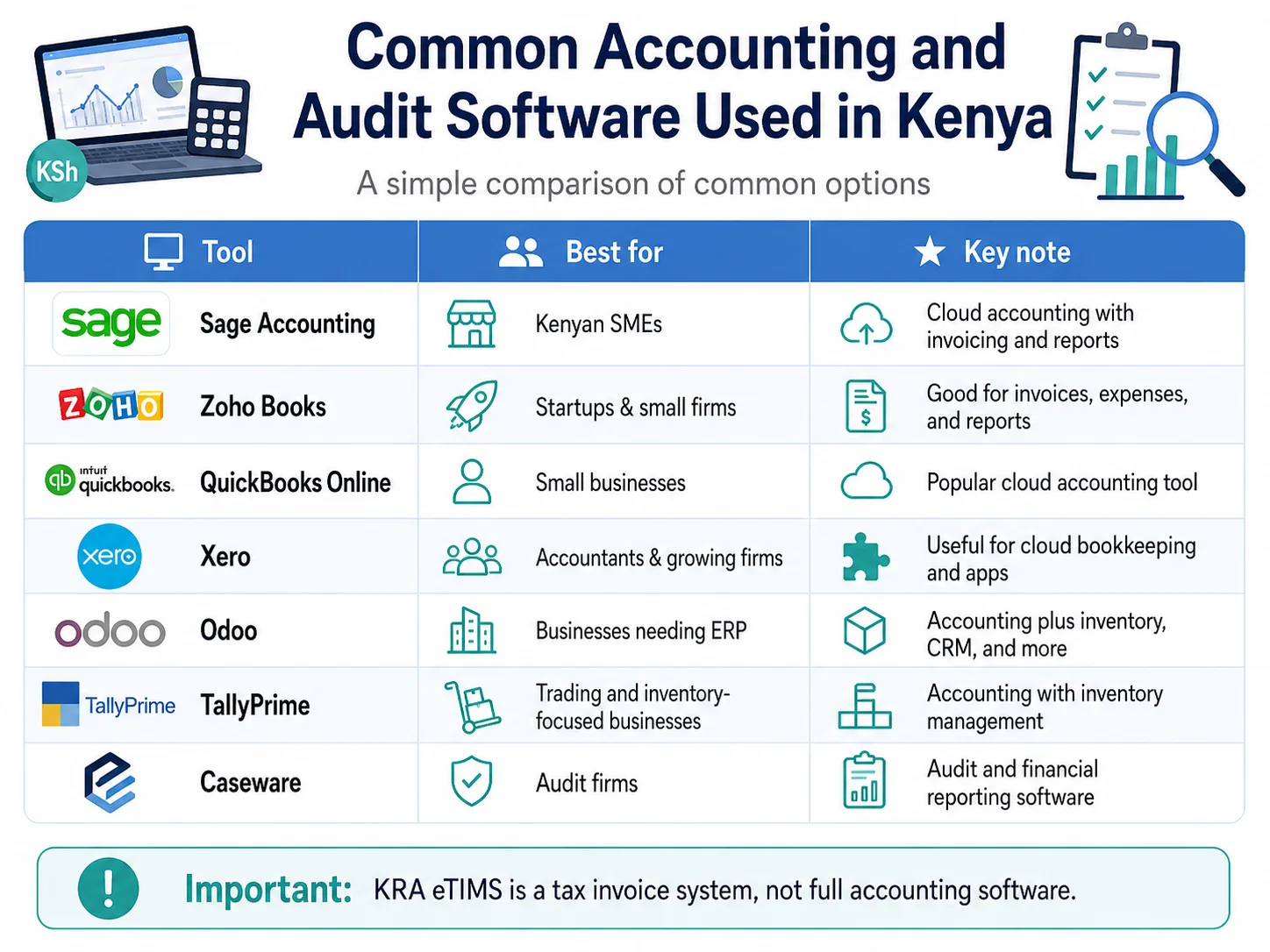
Choosing common account audit software used in Kenya is not just about picking a famous brand. Kenyan businesses also need clean bookkeeping, reliable reports, tax invoice records, audit-ready documents, user controls, and proper data protection.
This guide explains the main types of accounting and audit software Kenyan users may consider, including cloud accounting tools, ERP systems, audit working-paper software, and KRA-related eTIMS requirements. It also explains what each option is better for, what to avoid, and why you should not trust any article that claims one tool is officially “the most used” without evidence.
This is a source-based research guide, not a hands-on software test.
Quick Verdict
Best for: Kenyan small businesses, accountants, bookkeepers, auditors, NGOs, retailers, service businesses, and finance teams comparing accounting or audit tools.
Not ideal for: Anyone looking for one officially ranked “most used” software in Kenya. No credible public source confirms a single official ranking.
Main benefit: The right software can improve invoicing, bookkeeping, reporting, reconciliation, document control, and audit preparation.
Main concern: Many tools are global platforms, so Kenya-specific tax handling, eTIMS workflow, local support, and data privacy must be checked before purchase.
Better alternative if relevant: If your main need is statutory audit file management, compare audit-specific tools like Caseware instead of relying only on bookkeeping software.
What This Article Does Differently
Most competitor articles only list software names. That is weak and not enough for a serious business decision.
This article separates accounting software from audit software, explains where eTIMS fits, highlights privacy and compliance risks, and avoids unsupported claims. It also tells you when a tool may be the wrong choice, which is usually the part that SEO articles skip.
What This Keyword Really Means for Kenyan Businesses?
The phrase “common account audit software used in Kenya” usually refers to software used for accounting, bookkeeping, financial reporting, tax invoice records, audit preparation, and audit documentation.
In simple terms, these tools help businesses record income, expenses, invoices, bills, bank transactions, inventory, taxes, and reports. Some tools focus on daily accounting. Others focus on audit work papers, financial statement preparation, or ERP-level business management.
For Kenya, the decision should consider four practical needs:
- Daily bookkeeping and invoicing
- Tax invoice workflow and eTIMS awareness
- Financial reporting and audit preparation
- Privacy, user access, and data security
A small shop, a consultant, and an audit firm do not need the same software. That is where many people make the wrong decision.
How We Reviewed This Topic
This is a source-based review. It is based on publicly available official information from software providers, KRA guidance, privacy-related sources, official pricing pages, product documentation, and public product pages.
Hands-on testing was not performed. No performance claims, rankings, ratings, screenshots, or user experience claims are included unless supported by public official information.
The review looked at:
- Official product pages
- Official pricing pages where available
- KRA eTIMS information
- Kenya data protection guidance
- Product feature pages
- Audit software information
- Publicly available vendor documentation
Where information was not clearly available, this article says: “Not clearly mentioned by the official source.”
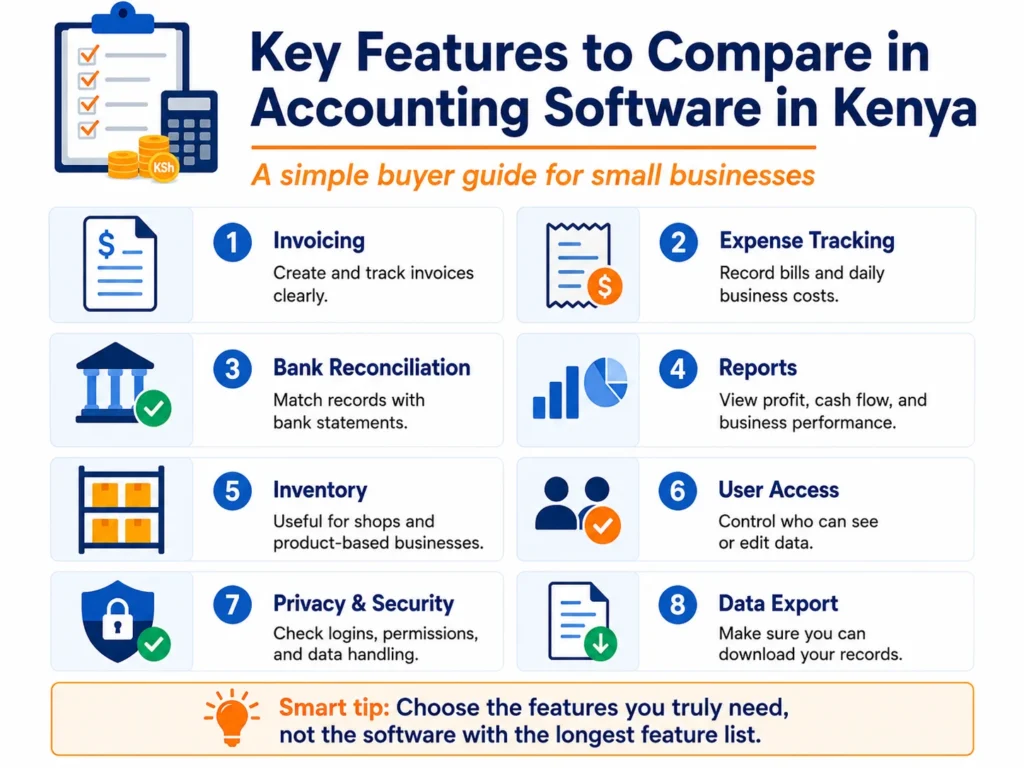
Key Features
The features below are commonly relevant when comparing accounting and audit software for Kenya. Only confirmed public features from official or credible sources are included.
Invoicing and Quotes
Many accounting tools support invoices, quotes, and sales documents. This is useful for service businesses, consultants, retailers, agencies, and SMEs that need clean billing records.
Expense and Bill Tracking
Accounting software usually helps record supplier bills, expenses, payments, and business costs. This matters because poor expense tracking creates weak books and messy audit preparation.
Bank Reconciliation
Bank reconciliation helps match bank transactions with accounting records. It reduces manual checking and helps identify missing or duplicate entries.
Financial Reports
Most accounting software provides reports such as profit and loss, balance sheet, tax summaries, receivables, payables, and cash flow-related views. Report depth depends on the tool and plan.
Inventory Support
Some tools include inventory features. Others offer inventory as an add-on or part of a larger ERP setup. Retailers, distributors, restaurants, and product-based businesses should check this before choosing software.
Multi-User Access
Some tools allow accountants, bookkeepers, business owners, or team members to access the same account with different user permissions. This is important for control and accountability.
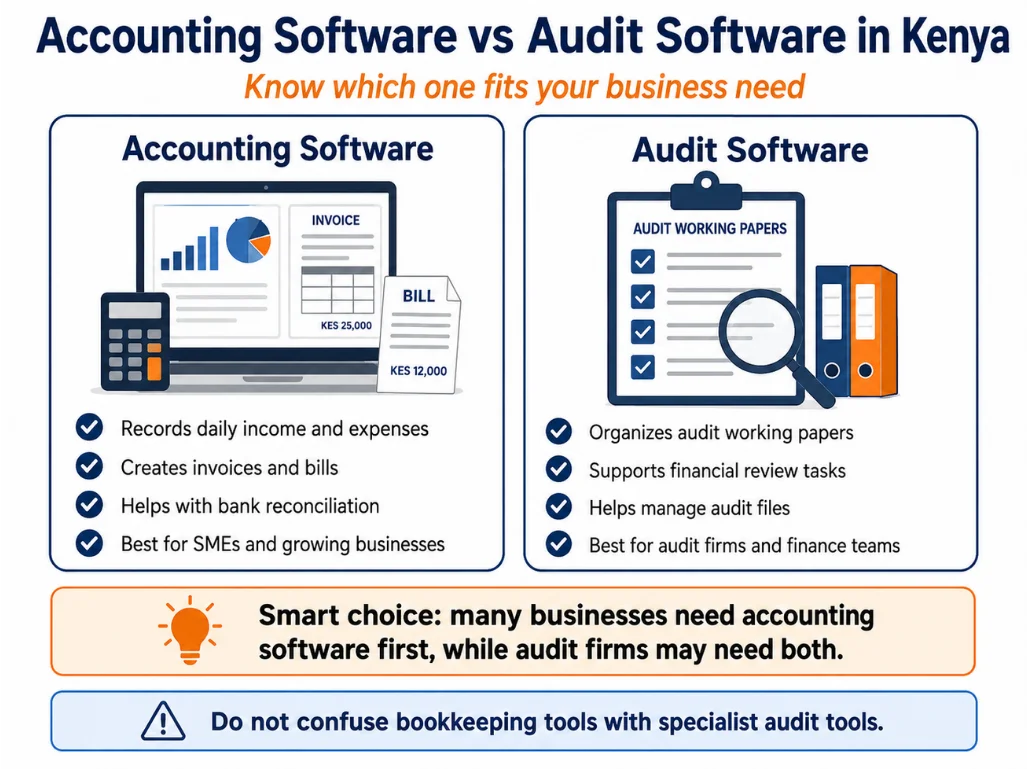
Audit and Working Paper Support
Audit-specific tools are different from normal accounting software. They help auditors manage engagement files, working papers, financial statements, trial balance imports, and audit documentation.
eTIMS Awareness or Integration
Kenya businesses should not ignore eTIMS. KRA provides eTIMS as an electronic tax invoice solution, and system-to-system integration exists for businesses with invoicing or ERP systems. However, whether a specific accounting software directly supports your eTIMS workflow is not always clearly mentioned by the official source.
Not Clearly Mentioned by the Official Source
The following points are not clearly confirmed across all providers:
- A public official ranking of the most used accounting software in Kenya
- Guaranteed eTIMS integration for every software listed
- Full Kenya tax compliance for every plan
- Local support quality for every provider
- Exact pricing for every reseller or implementation partner
- Audit suitability for every business type
How It Works
Accounting and audit software usually works in a simple flow.
Step 1: Set Up the Business Profile
You enter your business name, currency, tax settings, users, and basic company details. In Kenya, you should also check whether your tax invoice process connects properly with your eTIMS workflow.
Step 2: Create a Chart of Accounts
The chart of accounts organizes your income, expenses, assets, liabilities, and equity. If this is poorly set up, your reports will be weak even if the software is good.
Step 3: Record Sales and Purchases
You create invoices, record supplier bills, track customer payments, and record expenses. Good software makes this easier, but it does not fix wrong entries automatically.
Step 4: Reconcile Bank and Cash Transactions
Bank reconciliation helps you compare your accounting records with bank statements. This is one of the most important steps before preparing reports.
Step 5: Store Supporting Documents
Receipts, invoices, contracts, purchase orders, and payment evidence should be stored properly. Auditors need evidence, not just figures.
Step 6: Generate Reports
You can generate financial reports such as profit and loss, balance sheet, receivables, payables, tax summaries, and cash flow-related reports.
Step 7: Share Records With an Accountant or Auditor
Some cloud tools allow access for accountants or bookkeepers. Audit-specific tools may allow deeper audit file management, trial balance mapping, and working paper preparation.
Step 8: Review Compliance Gaps
Software should not replace professional judgment. You still need to check tax treatment, eTIMS requirements, audit evidence, access control, and data privacy.
Pricing or Availability
Pricing depends on the software, plan, country page, number of users, features, add-ons, and whether implementation support is needed.
Some tools publish clear subscription pricing. Others rely on resellers, partners, demos, custom quotes, or implementation packages.
Here is the honest position:
- QuickBooks Online: Paid cloud accounting software. Global pricing is publicly listed, but Kenya-specific tax or eTIMS suitability is not clearly mentioned by the official source.
- Sage Accounting Kenya: Paid cloud accounting software with Kenya-focused pages and published pricing in USD on the Kenya page.
- Xero: Paid cloud accounting software with free trial information and global pricing. Kenya-specific tax handling should be checked before use.
- Zoho Books: Cloud accounting software with free and paid plans. Kenya is listed in Zoho Books editions, but plan suitability should still be checked.
- Odoo: ERP and accounting platform with free and paid plans. Implementation needs may increase cost.
- TallyPrime: Business management and accounting software. Pricing and Kenya availability may depend on local partners or resellers.
- Caseware: Audit and financial reporting software. Pricing is not clearly listed on the public source checked and may require contacting the provider or partner.
- KRA eTIMS: Not normal accounting software. It is a tax invoice system provided by KRA, and businesses should review KRA guidance directly.
Safety and Privacy Check
Accounting software handles sensitive information. That includes invoices, customer details, supplier records, bank data, payroll-related details, tax records, and internal financial performance.
Before choosing software, check these points carefully.
Login and User Access
Use software that supports secure login, user roles, and controlled access. Do not give every employee full admin rights. That is lazy management and creates unnecessary risk.
Data Location and Cloud Storage
Cloud tools store data online. That may be convenient, but you should understand where your data is stored, who can access it, and how backups work.
Privacy Policy
Read the vendor privacy policy before adding financial data. If the policy is vague, difficult to find, or unclear about data sharing, that is a red flag.
Bank Connections
Some tools allow bank feeds or financial integrations. These can save time, but they also require careful permission management.
eTIMS and Tax Data
For Kenya, check how your invoicing process works with eTIMS. Do not assume a global accounting tool automatically solves local tax invoice requirements.
Data Protection in Kenya
Kenya has an official data protection framework. Businesses handling personal data should consider privacy, lawful processing, access control, breach handling, and data subject rights.
Main Red Flags
Avoid software or vendors when:
- Pricing is hidden without any clear reason
- No privacy policy is available
- No support channel is visible
- The vendor makes broad tax compliance claims without proof
- The system has weak access controls
- You cannot export your data
- eTIMS compatibility is promised verbally but not documented
- The reseller cannot explain implementation, backup, or support terms
Pros and Cons
Pros
- Helps reduce messy manual bookkeeping
- Improves invoice, expense, and payment tracking
- Makes reports easier to prepare
- Supports better audit readiness
- Helps accountants and business owners collaborate
- Can improve document organization
- May reduce spreadsheet errors when properly used
- Some tools support inventory, approvals, and multi-user access
Cons
- Software does not guarantee tax compliance
- Kenya-specific features vary by provider
- eTIMS integration must be checked separately
- Cloud tools create privacy and access-control responsibilities
- Subscription costs can rise with users, add-ons, or implementation
- Poor setup can create inaccurate reports
- Audit firms may still need specialist audit software
- Some tools may be too complex for very small businesses
Comparison Table
| Software / Tool | Type | Better For | Confirmed Strengths | Main Limitation |
| Sage Accounting Kenya | Cloud accounting software | Kenyan SMEs, sole traders, small businesses | Invoicing, bank reconciliation, VAT returns, online access, user options | Some features and add-ons increase cost |
| Zoho Books | Cloud accounting software | Solopreneurs, micro businesses, SMEs | Invoicing, expenses, reports, bank reconciliation, tax reports, free and paid plans | Kenya-specific tax workflow must be checked |
| QuickBooks Online | Cloud accounting software | Small businesses and accountants | Invoicing, expenses, reports, bills, bank connections, accountant access | Kenya-specific eTIMS support is not clearly mentioned by the official source |
| Xero | Cloud accounting software | Small businesses, accountants, bookkeepers | Invoicing, bills, expenses, app integrations, accountant tools | Kenya-specific tax handling should be verified |
| Odoo Accounting | ERP/accounting platform | Businesses needing accounting plus inventory, POS, CRM, projects | Integrated business apps, accounting, inventory, POS, paid plans, free one-app option | Setup can be more complex than simple accounting tools |
| TallyPrime | Business management/accounting software | Businesses needing accounting and inventory control | Accounting, inventory, banking, business reports | Kenya pricing and official local implementation details may depend on partners |
| Caseware Africa | Audit and financial reporting software | Audit firms and finance professionals | Audit, financial statement, business services, corporate reporting solutions | Not a basic bookkeeping tool |
| KRA eTIMS | Electronic tax invoice system | Kenyan taxpayers and businesses issuing electronic tax invoices | Electronic tax invoice support, taxpayer access, system-to-system integration options | Not a full accounting or audit software replacement |
Best Alternatives
Sage Accounting Kenya
Sage Accounting is a strong option to compare first if you want a Kenya-focused accounting software page with published pricing and features. It suits small businesses that need invoicing, bank reconciliation, VAT-related features, and online access.
Choose it when you want a more locally presented accounting option and do not want to rely only on global product pages.
Zoho Books
Zoho Books is worth considering for solopreneurs, micro businesses, startups, and small businesses that want cloud accounting with invoices, expenses, reports, customer portal features, and different plan levels.
Choose it when you want a cloud-based option with a free plan and room to upgrade. Still, confirm Kenya-specific tax requirements before relying on it fully.
QuickBooks Online
QuickBooks Online is widely known globally and offers small business accounting features such as invoices, expenses, reports, bills, and accountant access.
Choose it when your accountant already works with QuickBooks or when you need a familiar cloud accounting system. Do not assume Kenya-specific tax or eTIMS compatibility without checking.
Xero
Xero is another global cloud accounting platform used by small businesses, accountants, and bookkeepers. It offers accounting tools, app integrations, and accountant-focused products.
Choose it when you want a clean cloud accounting platform and your accountant supports it. Verify Kenya-specific requirements first.
Odoo
Odoo is better when accounting is only one part of your business system. It may suit businesses that also need CRM, inventory, POS, eCommerce, projects, or manufacturing modules.
Choose it when your business needs an integrated ERP-style system. Avoid it if you only need simple bookkeeping and do not have time for setup.
Caseware
Caseware is not a normal small-business bookkeeping tool. It is more relevant for audit firms, accounting practices, and finance teams that need audit, financial reporting, working paper, or engagement file solutions.
Choose it when your problem is audit documentation, not daily invoicing.
Who Should Use It?
You should consider accounting or audit software if you are:
- Running a registered business in Kenya
- Issuing invoices regularly
- Tracking customer payments and supplier bills
- Preparing reports for management or tax purposes
- Working with an accountant or bookkeeper
- Preparing for audit or external review
- Managing inventory or multiple branches
- Tired of messy spreadsheets
- Handling financial records that need proper access control
Who Should Avoid It?
You should avoid buying software immediately if:
- You do not know your accounting needs
- You have not checked eTIMS requirements
- You cannot confirm pricing or support
- You only need a very simple cash record
- You do not have someone who can set it up correctly
- The vendor cannot explain data backup and privacy
- You are choosing based only on a blog list
- You need audit working papers but are looking only at bookkeeping tools
The uncomfortable truth is simple: software will not fix poor financial discipline. If your records are incomplete, your reports will still be unreliable.
Practical Tips
Start With Your Real Problem
Do not start with software names. Start with your problem.
Ask yourself:
- Do I need invoicing?
- Do I need inventory?
- Do I need payroll?
- Do I need eTIMS integration?
- Do I need audit files?
- Do I need bank reconciliation?
- Do I need multi-user access?
- Do I need accountant collaboration?
Your answer decides the software category.
Check eTIMS Early
For Kenya, eTIMS is too important to leave until the end. Ask the vendor or implementer exactly how invoices will be handled.
Do not accept vague answers like “yes, it supports tax.” Ask for documentation.
Do Not Overbuy
A small consultant does not need a heavy ERP system on day one. A growing retailer may outgrow basic bookkeeping software quickly. Buy based on your next 12 to 24 months, not ego.
Ask Your Accountant Before Paying
Your accountant or auditor may already prefer certain tools. Ignoring them can create extra work later.
Test Export Options
You should be able to export reports and data. If your data is trapped inside the system, you are taking a serious business risk.
Control User Permissions
Only give each user the access they need. The owner, accountant, cashier, sales staff, and auditor should not all have the same permissions.
Keep Documents Outside the Software Too
Software can fail. Accounts can be locked. Subscriptions can expire. Keep proper backups of key reports, tax invoices, receipts, and legal documents.
Do Not Confuse Accounting Software With Audit Software
Bookkeeping software records transactions. Audit software supports audit work. They overlap, but they are not the same thing.
Internal Linking Suggestions
Kenyan businesses that want to compare software costs before choosing a tool can read this guide on accounting software pricing in Kenya.
If your business deals with tax records, invoices, or VAT returns, this guide on VAT accounting software in Kenya can help you understand the basics.
Before selecting any accounting tool, it is better to review this simple guide on how to choose accounting software in Kenya.
Small businesses that still depend on spreadsheets can compare accounting software vs Excel for Kenyan SMEs before making a decision.
If you want to compare popular tools, this guide on QuickBooks vs Sage vs Zoho Books in Kenya gives a clear side-by-side overview.
For small companies looking for beginner-friendly tools, this list of best accounting software for small businesses in Kenya may be useful.
Businesses that need tax-compliant tools should also understand eTIMS compliant accounting software in Kenya.
If you are new to Kenya’s electronic tax system, start with this simple explanation of what is eTIMS in Kenya.
Final Verdict
There is no single officially confirmed “best” or “most used” account audit software in Kenya. Treat any article claiming that as suspicious unless it provides real evidence.
For most small businesses, start by comparing Sage Accounting Kenya, Zoho Books, QuickBooks Online, Xero, and Odoo based on invoicing, reports, bank reconciliation, user access, pricing, support, and eTIMS workflow.
For audit firms or professional audit documentation, compare audit-specific tools like Caseware instead of relying only on normal accounting software.
The smartest decision is not choosing the most famous name. It is choosing the tool that matches your business size, tax workflow, accountant’s process, privacy needs, and reporting requirements.
Read More: Business Software
FAQs
1. What is the common account audit software used in Kenya?
- There is no official public ranking that confirms one most common account audit software used in Kenya. Businesses may consider tools such as Sage Accounting, Zoho Books, QuickBooks Online, Xero, Odoo, TallyPrime, Caseware, and KRA eTIMS depending on their needs.
2. Is eTIMS accounting software?
- No. eTIMS is an electronic tax invoice system from KRA. It supports tax invoicing, but it does not replace full accounting software for bookkeeping, reporting, reconciliation, and audit preparation.
3. Which software is better for small businesses in Kenya?
- Sage Accounting Kenya, Zoho Books, QuickBooks Online, and Xero are worth comparing for small businesses. The better choice depends on your invoicing needs, tax workflow, accountant support, pricing, and required features.
4. Which software is better for audit firms?
- Audit firms should consider audit-focused tools such as Caseware if they need engagement files, working papers, trial balance mapping, and financial statement preparation. Normal bookkeeping tools may not be enough.
5. Can accounting software guarantee Kenya tax compliance?
- No. Software can support records and invoicing, but it does not guarantee compliance. You still need correct setup, proper tax treatment, eTIMS awareness, and professional advice where necessary.
6. Is cloud accounting software safe?
- Cloud accounting can be safe when the vendor has strong security, clear privacy policies, user permissions, backup options, and good account protection. It becomes risky when users share passwords, ignore permissions, or choose unknown vendors.
7. Should I use Excel instead of accounting software?
- Excel can work for very simple records, but it becomes risky as transactions grow. It has weak audit trails, higher error risk, and limited access control compared with proper accounting software.

Charles Brook is the Founder of Vantiro Media and a University of Nairobi (B.Com) graduate. As a business software specialist, he helps Kenyan SMEs navigate eTIMS compliance, compare tools like QuickBooks, Zoho, & Sage, and choose the best budget-friendly accounting systems.
Kenya SME Software Brief
Need Help Choosing Accounting Software in Kenya?
Get simple buying tips, eTIMS guidance, VAT record advice, pricing comparisons, and software recommendations for Kenyan SMEs.
- eTIMS tips
- VAT records
- Pricing guides
- Software comparisons
No spam. Just useful Kenya business software updates and simple accounting guides.
Free Checklist