
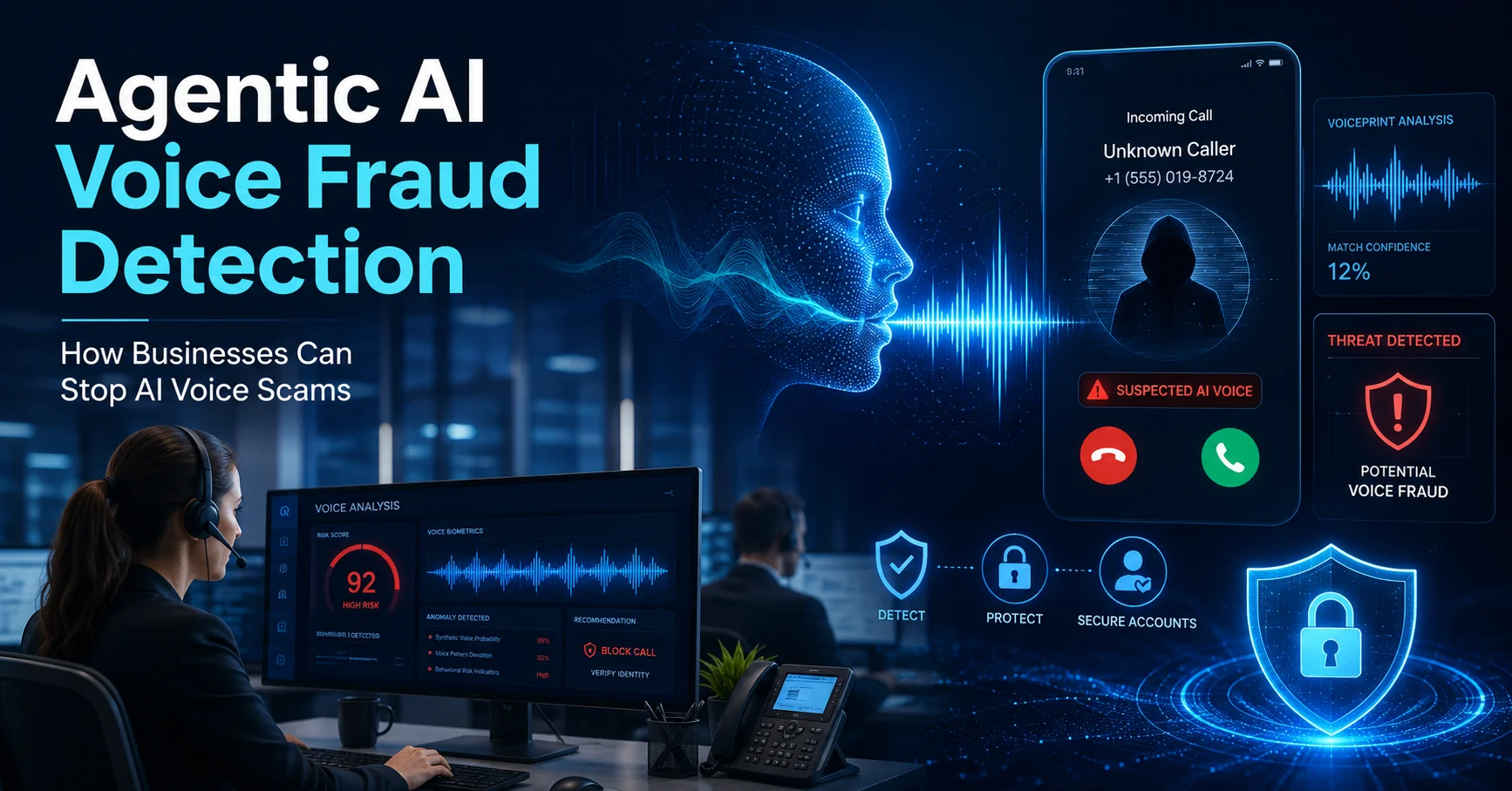
Agentic AI voice fraud detection is becoming important because voice scams are no longer simple fake phone calls. Fraudsters can now use AI tools to copy voices, hold natural conversations, answer questions, and pressure support teams into making unsafe account changes. For banks, fintech apps, insurance companies, healthcare platforms, and customer support teams, this is a serious security problem.
The biggest mistake businesses make is thinking that a familiar voice proves identity. It does not. In the age of AI voice cloning, a caller can sound like a real customer, employee, manager, or family member. That is why businesses need a better way to detect voice fraud before damage happens.
What Is Agentic AI Voice Fraud?
Agentic AI voice fraud happens when AI systems are used to carry out voice-based scams with more independence and intelligence. A basic voice clone only copies how someone sounds. Agentic AI goes further. It can understand the conversation, respond naturally, follow a fraud goal, and adjust its answers during the call.
For example, a scammer may use AI to imitate a customer and call a bank support team. The AI-powered voice may say the customer lost access to their account and needs an urgent password reset. If the support agent relies only on voice, caller ID, or basic security questions, the fraudster may get access.
This is why agentic AI voice fraud detection matters. It helps businesses decide whether a voice interaction is genuine, risky, synthetic, or suspicious.
Why Voice Fraud Is Becoming More Dangerous
Voice fraud is becoming more dangerous for three main reasons.
First, AI voices sound more realistic than before. Older fake voices often sounded robotic, but modern AI voices can include emotion, pauses, accents, and natural rhythm. In a busy contact center, an agent may not notice the difference.
Second, voice samples are easy to find. Many people have videos, podcasts, interviews, webinars, social media clips, or voice notes online. Fraudsters may use these public samples to create a fake voice.
Third, AI can scale attacks. A human scammer can only make a limited number of calls in a day. AI-assisted systems can help test scripts, repeat attempts, and target many accounts faster. That means companies may face more fraud attempts, not just better fraud attempts.
How Agentic AI Voice Fraud Detection Works
Agentic AI voice fraud detection does not depend on one signal. A strong system looks at multiple clues together.
It may analyze the voice itself, including tone, pitch, rhythm, pronunciation, pauses, and audio patterns. Some AI-generated voices leave technical signs that detection tools can identify.
It may also check liveness. Liveness detection helps decide whether the voice is coming from a real live speaker or from synthetic audio, a replayed recording, or direct audio injection.
Another important layer is behavioral analysis. A suspicious caller may rush the agent, avoid normal checks, repeat urgent excuses, request a password reset, ask to change a phone number, or try to access payment details. These actions can increase the risk score.
The system can also review call metadata, such as phone number reputation, call routing, device signals, location mismatch, previous call history, and account activity. A voice may sound real, but the full interaction may still look risky.
How Contact Centers Can Detect AI Voice Fraud
Contact centers are one of the biggest targets because agents are trained to help people quickly. Fraudsters know this and use pressure tactics.
A practical detection process should start before the agent even answers the call. The system should check the caller’s number, previous contact history, device signals, and account risk. If the caller is already risky, the agent should see a warning.
During the call, the system should analyze the voice in real time. It should look for synthetic speech, unusual audio patterns, replay attacks, and suspicious behavior. If the caller requests a sensitive action, such as account recovery or payment change, the system should require stronger verification.
After the call, suspicious cases should be reviewed by a fraud team. Call recordings, agent notes, risk scores, and account changes should be checked together. This helps the company improve future detection.
For businesses exploring how voice intelligence, agentic AI, and biometric identity can work together, this related guide on a layered identity security model explains the wider connection between agentic AI, Pindrop-style voice security, and privacy-focused biometric protection.
Common Signs of AI Voice Fraud
AI voice fraud is not always easy to spot, but there are warning signs.
A caller may create urgency and say they need immediate help. They may claim they are locked out, traveling, under pressure, or dealing with an emergency. This is designed to make the agent skip normal checks.
The caller may also avoid open-ended questions. If an agent asks something unexpected, the response may become vague or repetitive.
There may be unnatural pauses, strange background noise, audio glitches, or a voice that sounds slightly too clean. However, businesses should not depend only on human hearing. Some fake voices sound convincing enough to fool trained people.
Another warning sign is a request to change key account details. Phone number changes, email changes, password resets, payment changes, and account recovery requests should always be treated carefully.
Voice Fraud Detection Checklist for Businesses
A business should not rely only on passwords or security questions. Those methods are weak because personal information can be stolen, leaked, guessed, or found online.
A better voice fraud defense should include:
Voice risk analysis to detect synthetic speech and deepfake audio.
Liveness detection to confirm the caller is a real live speaker.
Call metadata analysis to check number reputation, routing, location, and device signals.
Behavioral monitoring to detect pressure tactics, unusual requests, and suspicious patterns.
Step-up authentication for high-risk actions such as password resets, payment changes, and account recovery.
Agent training so support staff understand that a familiar voice is not proof of identity.
Human review for high-risk cases where automated systems are not enough.
Mistakes Businesses Should Avoid
The first mistake is trusting caller ID. Caller ID can be spoofed, so it should never be treated as proof.
The second mistake is relying only on security questions. Questions like date of birth, address, or mother’s maiden name are not strong enough anymore.
The third mistake is treating voice biometrics as the only defense. Voice can still be attacked, so it should be part of a layered system, not the whole system.
The fourth mistake is ignoring agent training. Even the best technology can fail if human teams are pressured into bypassing process.
The fifth mistake is waiting for a major fraud loss before improving security. By the time a company sees serious losses, the fraud pattern may already be active.
What Customers Can Do to Stay Safe
Customers should also be careful. If someone calls and claims to be a bank, company, relative, or manager, do not trust the voice alone. Hang up and call back using the official number from the company’s website or app.
Families can also create a private safety phrase for emergencies. This is useful because scammers may clone the voice of a child, parent, or relative and create a fake crisis.
People should avoid sharing long, clear voice recordings publicly when possible. This does not mean everyone must stop posting videos, but it does mean being careful with how much personal voice data is available online.
Future of Agentic AI Voice Fraud Detection
The future of voice fraud detection will be based on layered trust. Businesses will need systems that combine voice analysis, identity verification, behavioral signals, device intelligence, and human oversight.
Real-time detection will become more important because waiting until after the call may be too late. If a fraudster changes account details or moves money during the call, the damage is already done.
The goal is not to block every AI voice. Some AI voice tools are useful and legitimate. The real goal is to detect deception, impersonation, and risky behavior.
FAQs About Agentic AI Voice Fraud Detection
What is agentic AI voice fraud detection?
Agentic AI voice fraud detection is the process of identifying AI-assisted voice scams, cloned voices, synthetic speech, and suspicious call behavior before fraud happens.
Can AI clone a person’s voice?
Yes, AI tools can create realistic voice clones from voice samples. The quality depends on the tool, the available audio, and how the cloned voice is used.
Is voice authentication still useful?
Yes, but it should not be used alone. Voice authentication works better when combined with liveness detection, device signals, behavioral analysis, and step-up verification.
Which businesses need voice fraud detection most?
Banks, fintech companies, insurance providers, healthcare platforms, contact centers, payment companies, and businesses handling sensitive customer accounts need it most.
What is the best way to stop AI voice fraud?
The best approach is layered security. Businesses should combine voice fraud detection, liveness checks, account risk scoring, agent training, and stronger verification for sensitive actions.
Final Thoughts
Agentic AI voice fraud detection is no longer optional for businesses that handle sensitive accounts or customer data. Voice scams are becoming smarter, faster, and harder to detect with old methods.
The main lesson is simple: a voice is not identity. Businesses must verify the full interaction, not just the sound of the caller. A strong defense uses multiple signals, real-time risk checks, trained agents, and stronger verification for sensitive actions.
Companies that act early will reduce fraud risk and protect customer trust. Companies that wait will learn the hard way that AI voice fraud is not a future problem. It is already here.

Nora Ryan is an AI and technology writer at VantiroMedia with 6 years of experience writing about artificial intelligence, emerging tech trends, digital tools, apps, and online platforms. She studied at University of Texas at Austin, where she developed a strong interest in technology, digital communication, and practical online learning. Through her work, Nora helps readers understand complex digital topics in a clear, simple, and useful way.