
Software licenses look small when you buy them one by one.
A few Adobe licenses.
A few ServiceNow seats.
Some CRM users.
Some security tools.
Some cloud software subscriptions.
But over time, these small purchases can turn into a serious budget problem.
That is why DOGE software licenses audit HUD has become an important topic. It highlights a bigger issue that many government departments, companies, IT teams, and business owners face every day: they often do not know how many software licenses they own, how many are being used, and how much money is being wasted.
In simple words, this topic is not only about DOGE or HUD. It is about software waste, license tracking, compliance risk, and smarter IT spending.
If an organization does not audit its software licenses properly, it may keep paying for tools nobody uses. Even worse, it may fail a compliance review because the records are incomplete or inaccurate.
So, let’s break this down in a simple and useful way.
What Is DOGE Software Licenses Audit HUD?
DOGE software licenses audit HUD refers to the discussion around software license auditing connected with HUD, the U.S. Department of Housing and Urban Development, and DOGE-related public updates about unused or underused software licenses.
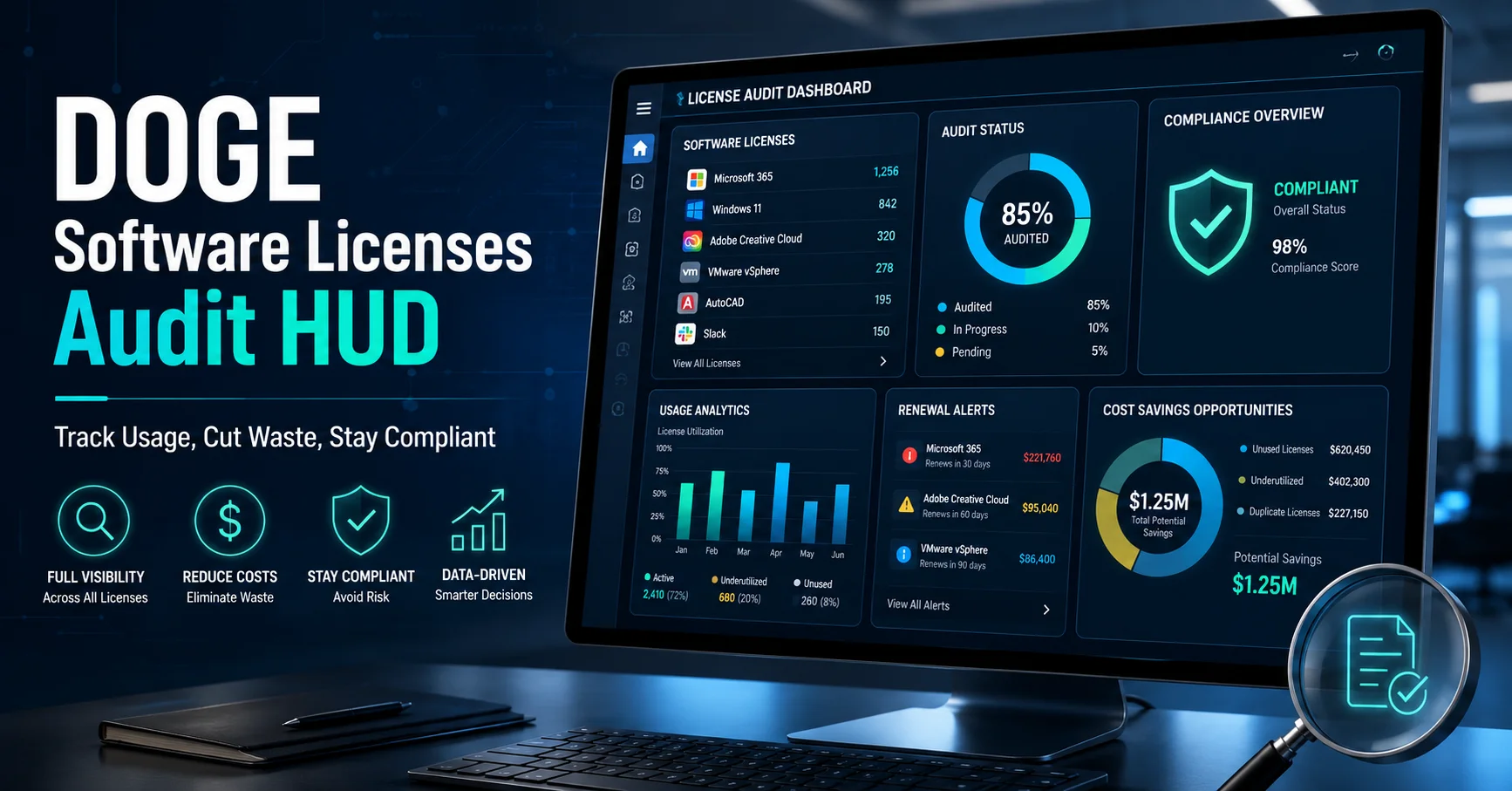
Here, “HUD” can also be understood practically as a dashboard-style view, or heads-up display, that shows software license data in one place.
A proper software license audit HUD helps organizations see:
- How many licenses they purchased
- How many licenses are actually active
- Which users are using the tools
- Which licenses are inactive
- Which subscriptions are duplicated
- Which renewals are coming soon
- Which software creates compliance risk
- Where money can be saved
This matters because software spending is not always visible. Many teams buy tools separately, and over time the organization loses control.
Why Software License Audits Are Important
A software license audit is not just an IT task. It is also a finance, compliance, and business strategy task. When software licenses are not tracked properly, organizations face three big problems.
1. Wasted Spending
The most obvious problem is wasted money. If a company pays for 500 licenses but only 250 people use them, the remaining licenses are pure waste. This usually happens because employees leave, teams change tools, or managers buy extra seats “just in case.” That thinking sounds safe, but it is expensive.
2. Poor Visibility
Many businesses do not have one clear place where all software licenses are listed. Finance may have invoices. IT may have admin access. HR may know which employees left. Procurement may know the contract dates. But if this data is scattered, nobody has the full picture. A license management dashboard solves this problem by bringing software inventory, usage, renewal, and cost data together.
3. Compliance Risk
Software vendors have license terms. Some licenses are user-based. Some are device-based. Some are enterprise-wide. Some only allow specific usage. If an organization uses software outside the allowed terms, it can face audit issues, penalties, or legal problems. This is why software license compliance should never be ignored.
What Businesses Can Learn from the HUD License Audit Discussion
The biggest lesson is simple:
You cannot manage software costs if you do not track software usage. Many organizations focus on buying new tools, but they do not spend enough time reviewing old tools. That is where the waste begins.
The DOGE HUD software license audit discussion shows why every organization should ask these questions:
- Are we paying for unused licenses?
- Are former employees still assigned to paid tools?
- Are different teams using similar software?
- Are renewals happening automatically without review?
- Do we know which licenses are business-critical?
- Do we have proof of license compliance?
If the answer is “no” or “not sure,” then the organization needs a better system.
How to Run a Software License Audit Step by Step
Here is a practical process any business can follow.
Step 1: Create a Full Software Inventory
Start by listing every software tool your organization uses.
Include:
- SaaS tools
- Desktop applications
- Cloud platforms
- Security software
- Design tools
- Accounting software
- CRM tools
- Project management tools
- Communication tools
- Developer tools
Do not ignore small subscriptions. Small tools often become a hidden cost when many employees use them.
Step 2: Match Licenses with Users
Next, match every license with a real user, device, team, or department.
This step helps you find:
- Inactive users
- Former employee accounts
- Duplicate accounts
- Unassigned licenses
- Over-purchased seats
- Tools nobody owns internally
This is where many companies immediately discover waste.
Step 3: Check Actual Usage
Now check whether the assigned users are actually using the software.
For example, ask:
- Did the user log in during the last 30 days?
- Is the tool used daily, weekly, or rarely?
- Has the license never been activated?
- Is the user assigned to a premium plan they do not need?
This step is important because an assigned license is not always a useful license.
Step 4: Find Duplicate Software
Many companies pay for multiple tools that do almost the same job.
For example, one team may use one project management platform while another team uses a different one. One department may use one design tool while another pays for another. A good software license audit HUD helps identify these overlaps. Then leadership can decide whether to standardize tools, reduce contracts, or keep separate tools for valid business reasons.
Step 5: Review Renewal Dates
Renewal dates are dangerous when nobody is watching them. Many software contracts auto-renew. If you miss the review window, you may be locked into another year of unnecessary spending. A strong license audit dashboard should show renewal dates clearly so you can take action before the deadline.
Step 6: Review Compliance Terms
Do not cancel or change licenses blindly. Some licenses may be required for security, legal, backup, contractors, or specific workflow needs. Some software may also be bundled under enterprise agreements. So, before removing licenses, review the vendor terms and business requirements. A smart audit does not only cut costs. It cuts waste without creating risk.
Best Features to Look for in a Software License Audit HUD
If you are planning to buy software for license tracking, choose carefully. A good software license management tool should include:
Real-Time Dashboard
You should be able to see license counts, users, costs, renewals, and risk areas from one dashboard.
Usage Analytics
The tool should show which licenses are active, inactive, lightly used, or unused.
Renewal Alerts
You need alerts before contracts renew, not after the money is already gone.
Compliance Reporting
The software should help you prepare reports for internal audits, vendor audits, and management reviews.
Department-Level Cost Breakdown
This helps finance teams see which departments are spending the most on software.
Duplicate Tool Detection
The system should help identify tools with overlapping functions.
Easy Integrations
A strong tool should connect with identity systems, HR records, finance platforms, vendor accounts, and device management tools where possible.
Why Buying a Software License Audit Tool Makes Sense
If your organization uses many paid tools, managing everything manually is not realistic anymore.
Spreadsheets become outdated.
Emails get lost.
Invoices do not show real usage.
Vendor dashboards only show one product at a time.
A proper software license audit HUD gives you control.
It helps you reduce waste, improve visibility, avoid compliance problems, and make better renewal decisions.
More importantly, it helps leaders make decisions based on data, not guesses.
This is where the product becomes valuable. It is not just another dashboard. It is a cost-control and compliance system.
If the tool helps you cancel unused licenses, downgrade unnecessary plans, prevent duplicate purchases, or negotiate better renewals, it can quickly pay for itself.
Final Thoughts
The DOGE software licenses audit HUD topic is important because it exposes a problem that exists in many organizations: software spending grows quietly when nobody audits it properly.
The solution is not panic-cutting every license. That would be careless.
The smart solution is visibility.
First, know what you bought.
Then, check who uses it.
After that, remove waste, fix compliance gaps, and improve renewal decisions.
If your organization still manages licenses manually, this is the right time to move toward a proper software license audit dashboard.
It will save time, reduce waste, and make software spending easier to control.
FAQs About DOGE Software Licenses Audit HUD
1. What does DOGE software licenses audit HUD mean?
- DOGE software licenses audit HUD refers to the discussion around auditing software licenses connected with HUD and DOGE-related public updates. It also points to the need for a dashboard that tracks license usage, waste, renewals, and compliance.
2. Why are unused software licenses a problem?
- Unused software licenses waste money because organizations keep paying for tools that employees do not use. They also make software spending harder to control.
3. What is a software license audit?
- A software license audit is the process of checking purchased licenses, assigned users, actual usage, renewal dates, and compliance terms.
4. Can a license audit dashboard save money?
- Yes. A license audit dashboard can help find inactive users, unused seats, duplicate tools, and unnecessary renewals. This can reduce software spending.
5. Who should use a software license audit tool?
- IT teams, finance teams, procurement teams, compliance officers, business owners, and government departments can all benefit from a software license management tool.
