
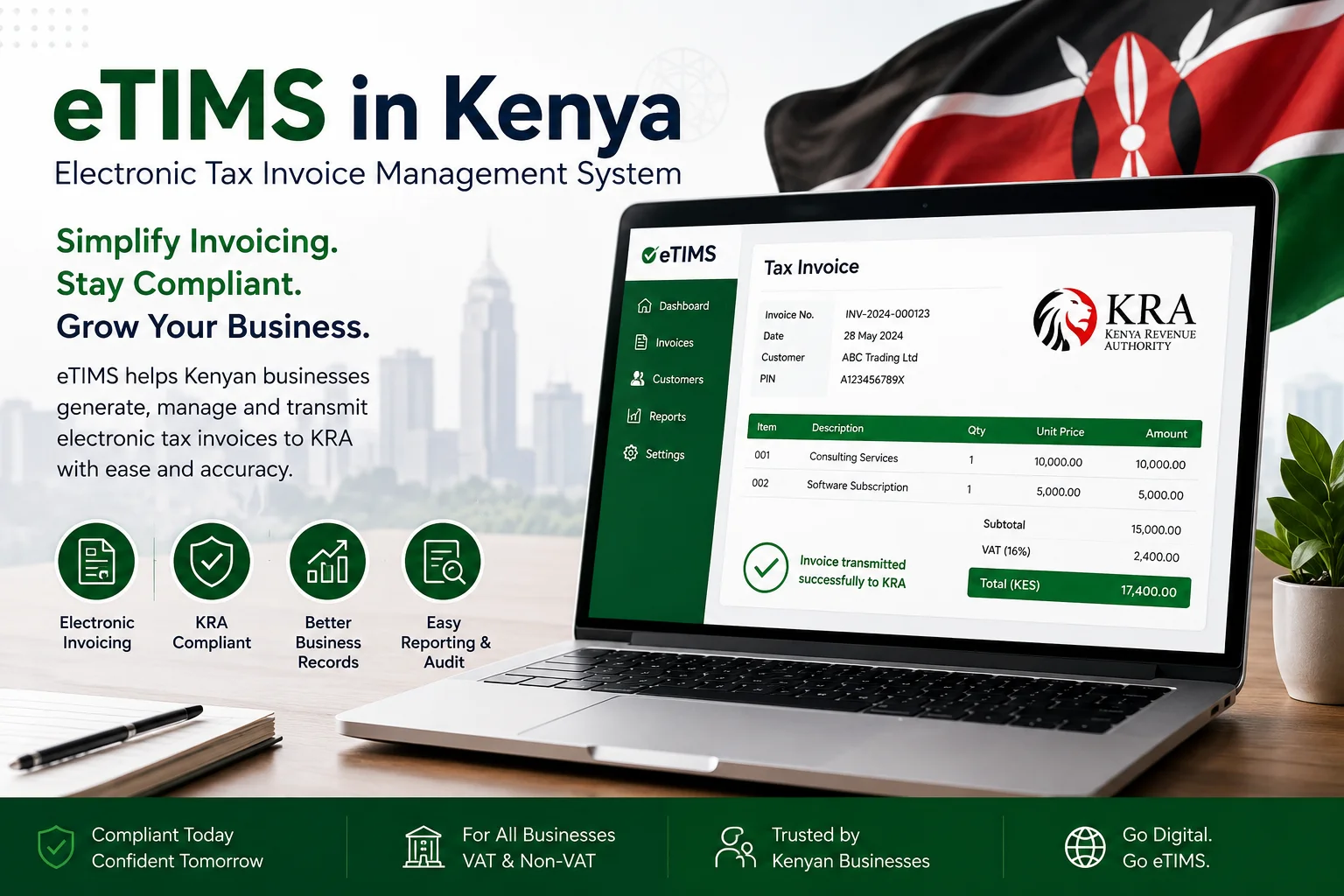
If you run a business in Kenya, eTIMS is no longer something you can ignore. Whether you are VAT-registered, non-VAT registered, a small trader, service provider, freelancer, shop owner, consultant, or growing SME, you need to understand how eTIMS works and why it matters for your tax compliance.
eTIMS in Kenya stands for electronic Tax Invoice Management System. It is a Kenya Revenue Authority system designed to help businesses generate, manage, and transmit electronic tax invoices. Instead of relying only on manual invoices or outdated invoicing methods, businesses can now issue electronic invoices that are recognized by KRA.
For many businesses, the real challenge is not only registering on eTIMS. The bigger issue is choosing the right invoicing or accounting setup that supports daily operations, VAT records, expense tracking, reports, and compliance. This is why many Kenyan SMEs now prefer using <a href=”https://vantiromedia.com/etims-compliant-accounting-software-in-kenya/“>eTIMS-compliant accounting software in Kenya</a> instead of handling invoices manually.
What Is eTIMS in Kenya?
eTIMS is KRA’s electronic invoicing system that allows businesses to generate and transmit invoices electronically. In simple terms, it helps KRA verify sales invoices and helps businesses keep proper tax records.
A valid eTIMS invoice usually supports better tax documentation because it is generated through a system recognized by KRA. This matters when filing taxes, preparing VAT returns, recording sales, and proving business expenses.
If you are new to the topic, you can first read this simple guide on <a href=”https://vantiromedia.com/what-is-etims-in-kenya/“>what eTIMS is in Kenya</a> before choosing a system for your business.
Who Needs eTIMS in Kenya?
eTIMS is important for most people carrying on business in Kenya. This includes:
- VAT-registered businesses
- Non-VAT registered businesses
- Retail shops and wholesalers
- Service-based businesses
- Consultants and freelancers
- SMEs and startups
- Companies issuing invoices to clients
- Businesses that want proper tax-deductible expense records
The mistake many business owners make is assuming eTIMS only applies to VAT-registered companies. That thinking is outdated. Kenya’s electronic invoicing rules have expanded, so even non-VAT businesses should take eTIMS seriously.
If your business sells goods or services and issues invoices, you should confirm your eTIMS obligation instead of waiting until tax filing becomes a problem.
Why eTIMS Matters for Kenyan Businesses
eTIMS is not just another tax system. It affects how your business records income, manages invoices, claims expenses, and stays compliant.
Here are the main reasons it matters:
1. It helps you issue valid electronic invoices
Clients, suppliers, and tax authorities increasingly expect proper electronic tax invoices. If your invoice is not valid, it may create problems for your customer’s expense claims or your own tax records.
2. It improves business record keeping
Manual invoices can easily get lost, duplicated, edited, or entered wrongly. eTIMS-supported systems reduce these risks by keeping better invoice records.
3. It supports VAT and tax compliance
If you are VAT-registered, eTIMS becomes even more important because your invoicing, VAT output records, and tax filing must stay aligned. You can also read our guide on <a href=”https://vantiromedia.com/vat-accounting-software-in-kenya-a-simple-guide-for-businesses/“>VAT accounting software in Kenya</a> to understand how VAT tracking works with accounting tools.
4. It makes audits easier
When records are clean, audits become less stressful. Businesses that use proper invoicing and accounting systems can access sales reports, invoice history, VAT records, and expense details more easily.
For a wider view of business audit tools, see this guide on <a href=”https://vantiromedia.com/common-account-audit-software-used-in-kenya/“>common account and audit software used in Kenya</a>.
5. It protects expense deductibility
For business expenses to be accepted during tax filing, proper supporting documents matter. A valid electronic tax invoice can be important when proving expenses.
How Does eTIMS Work?
The basic process is simple:
- A business registers or onboards to eTIMS.
- The business chooses a suitable eTIMS solution.
- The business creates invoices through an approved method.
- Invoice details are transmitted electronically to KRA.
- The business keeps invoice records for compliance and reporting.
The exact setup depends on the type and size of the business. A small trader may use a simple portal or app-based option, while a larger company may need system-to-system integration with accounting software or ERP software.
Types of eTIMS Solutions in Kenya
KRA provides different ways for taxpayers to use eTIMS. The right option depends on how your business operates.
eTIMS Portal
This may suit smaller businesses that issue fewer invoices and do not need a full accounting system. It can work for simple invoice generation, but it may become limited as the business grows.
eTIMS Mobile App
This can be useful for small businesses, mobile sellers, and service providers who need to create invoices from a phone.
eTIMS Client
This option is installed on a computer and can help businesses that prefer using desktop-based invoicing.
System-to-System Integration
This is usually better for businesses already using accounting software, POS systems, ERP systems, or custom invoicing systems. It allows the business system to connect with eTIMS so invoices can be transmitted more efficiently.
For many SMEs, the smartest route is not just “register on eTIMS.” The smarter route is choosing a full accounting setup that supports eTIMS, sales, purchases, VAT, reporting, and business growth. Start with this guide on <a href=”https://vantiromedia.com/accounting-software-in-kenya/“>accounting software in Kenya</a> if you want to compare the bigger picture.
eTIMS and Accounting Software in Kenya
A common problem for Kenyan businesses is using one tool for invoices, another tool for expenses, another spreadsheet for VAT, and another file for reports. This creates confusion.
A better setup connects invoicing with accounting. That means your business can manage:
- Sales invoices
- Customer records
- VAT records
- Expense tracking
- Supplier bills
- Financial reports
- Cash flow
- Tax documents
- Audit trails
This is where eTIMS-compliant accounting software becomes useful. It does not only help with invoices; it helps you manage the financial side of your business more professionally.
If you are still comparing options, read this guide on the <a href=”https://vantiromedia.com/best-accounting-software-for-small-businesses-in-kenya/“>best accounting software for small businesses in Kenya</a>.
eTIMS vs Manual Invoicing
Manual invoicing may look simple, but it becomes risky as the business grows.
| Area | Manual Invoicing | eTIMS / Digital Invoicing |
|---|---|---|
| Compliance | Higher risk of errors | Better tax compliance |
| Record keeping | Easy to lose records | Easier invoice history |
| VAT tracking | Often manual | Easier to track with software |
| Audit readiness | More stressful | More organized |
| Business growth | Hard to scale | Easier to manage volume |
| Reporting | Limited | Better reports |
If your business still depends heavily on spreadsheets, you should compare the risks in this guide: <a href=”https://vantiromedia.com/accounting-software-vs-excel-for-kenyan-smes-which-is-better/“>accounting software vs Excel for Kenyan SMEs</a>.
Benefits of eTIMS for Small Businesses in Kenya
Small businesses often see eTIMS as a burden. That is the wrong way to look at it. If handled properly, eTIMS can improve how the business operates.
Better invoice control
You can track invoices more clearly and reduce missing records.
Easier client trust
Professional invoices make your business look more serious and credible.
Cleaner tax records
When sales records are properly captured, tax filing becomes easier.
Reduced last-minute pressure
Instead of rushing to organize invoices at tax time, your records stay updated throughout the year.
Better business decisions
When eTIMS is combined with accounting software, you can understand sales, expenses, profit, and cash flow more clearly.
Common eTIMS Mistakes Businesses Make
Many businesses make the same mistakes when dealing with eTIMS.
Mistake 1: Waiting until there is a tax problem
Do not wait until a client rejects your invoice or KRA asks for proper records. Set up eTIMS early.
Mistake 2: Choosing software only because it is cheap
Cheap software can become expensive if it lacks proper support, reporting, VAT features, or eTIMS compatibility. Before choosing a tool, compare the real cost using this guide on <a href=”https://vantiromedia.com/accounting-software-pricing-in-kenya/“>accounting software pricing in Kenya</a>.
Mistake 3: Using eTIMS separately from accounting
If your eTIMS invoicing and accounting records are not connected, you may still face errors in reports and tax filing.
Mistake 4: Ignoring staff training
Even good software fails when staff do not know how to use it properly. Train your accounts team, sales team, and anyone who issues invoices.
Mistake 5: Not checking support quality
When invoicing fails, your business can lose time and clients. Choose a provider that gives proper local support.
How to Choose the Right eTIMS Setup
Before choosing an eTIMS solution or accounting software, ask these questions:
- Is my business VAT-registered or non-VAT registered?
- How many invoices do we issue per month?
- Do we need POS integration?
- Do we need inventory tracking?
- Do we need multi-user access?
- Do we need accountant access?
- Does the software support VAT reports?
- Can it handle growth?
- Is local support available in Kenya?
- Is the pricing clear?
If you are unsure, this guide on <a href=”https://vantiromedia.com/how-to-choose-accounting-software-in-kenya/“>how to choose accounting software in Kenya</a> can help you compare the right factors.
Popular Accounting Software Options for eTIMS in Kenya
Kenyan businesses often compare tools like QuickBooks, Sage, Zoho Books, and local accounting software providers. Each option has strengths and weaknesses.
Some are better for small businesses. Some are better for advanced reporting. Some are stronger for integrations. Some are easier for non-accountants. The best choice depends on your business size, invoice volume, VAT needs, budget, and support requirements.
For a detailed comparison, read <a href=”https://vantiromedia.com/quickbooks-vs-sage-vs-zoho-books-in-kenya/“>QuickBooks vs Sage vs Zoho Books in Kenya</a>.
eTIMS Compliance Checklist for Kenyan Businesses
Use this checklist to review your business:
- You understand whether your business must use eTIMS.
- Your business is onboarded on eTIMS.
- Your invoices are generated through a valid electronic method.
- Your staff know how to issue eTIMS invoices.
- Your sales records match your accounting records.
- Your VAT records are properly tracked if you are VAT-registered.
- Your expense invoices are properly stored.
- Your accounting software supports your compliance needs.
- You regularly review reports before tax filing.
- You have support when technical issues happen.
If you cannot tick most of these points, your business is exposed to avoidable compliance problems.
eTIMS for VAT-Registered Businesses
VAT-registered businesses need to be extra careful because VAT records must match invoices, sales, and tax returns. If invoices are missing or wrongly recorded, VAT filing can become complicated.
A proper system should help you track:
- VAT on sales
- VAT on purchases
- Customer invoices
- Credit notes
- Sales reports
- VAT return preparation
- Tax invoice records
This is why VAT-registered businesses should avoid weak manual processes. A proper accounting system can save time and reduce errors.
eTIMS for Non-VAT Businesses
Non-VAT businesses should not assume they are outside the eTIMS system. If you carry on business, issue invoices, and record income, you should understand your eTIMS obligations.
For non-VAT businesses, the focus is usually on:
- Issuing valid invoices
- Keeping proper sales records
- Supporting business expenses
- Creating professional documentation
- Preparing for future growth
Even if your business is small today, proper invoicing creates a cleaner foundation for tomorrow.
Is eTIMS Free in Kenya?
KRA provides eTIMS access options, but your total cost depends on how your business wants to manage invoicing and accounting.
For example, a small business using basic eTIMS tools may spend less. But a business that needs accounting software, integration, staff training, support, POS connection, or advanced reports may have extra software or service costs.
So the better question is not only “Is eTIMS free?” The better question is: “What setup will keep my business compliant and efficient without creating extra work?”
Final Thoughts
eTIMS in Kenya is now a key part of business compliance. It affects invoicing, VAT records, expense documentation, audits, and tax filing. Businesses that treat eTIMS as a serious accounting process will have fewer problems than businesses that only react when something goes wrong.
If you run a business in Kenya, do not rely on guesswork. Understand your eTIMS obligations, choose the right invoicing setup, and use accounting software that supports your business properly.
A clean eTIMS and accounting system helps your business stay compliant, organized, and ready for growth.
FAQs About eTIMS in Kenya
What does eTIMS mean in Kenya?
eTIMS means electronic Tax Invoice Management System. It is used for electronic tax invoicing and invoice transmission to KRA.
Is eTIMS required for all businesses in Kenya?
Most persons carrying on business in Kenya need to understand and comply with eTIMS requirements, including VAT and non-VAT businesses.
Do small businesses need eTIMS?
Yes, small businesses should take eTIMS seriously if they carry on business and issue invoices. The right setup depends on the size and nature of the business.
Is eTIMS only for VAT-registered businesses?
No. eTIMS is not only a VAT issue. Non-VAT businesses also need to understand electronic invoicing requirements.
Can accounting software help with eTIMS?
Yes. Good accounting software can help businesses manage invoices, VAT records, expenses, reports, and compliance more efficiently.
What is the best eTIMS solution for my business?
The best solution depends on your invoice volume, VAT status, business size, budget, reporting needs, and whether you need integration with accounting software or POS systems.