

Artificial intelligence is no longer just a buzzword in the Bay Area. It has become the center of the startup economy, pulling in engineers, investors, enterprise buyers, and global attention. When people search for the hottest ai startups in silicon valley, they usually want to know which companies are building real products, attracting serious funding, and changing how work gets done.
In this article, “Silicon Valley” refers to the broader Bay Area startup ecosystem, including San Francisco, Palo Alto, Mountain View, and nearby tech hubs. That matters because many of today’s leading AI startups are based in San Francisco rather than the traditional South Bay.
Why Silicon Valley Still Leads the AI Startup Race
Silicon Valley remains powerful because it combines three things that AI startups need badly: elite technical talent, venture capital, and early enterprise customers. AI companies need more than a smart idea. They need computers, data, distribution, and trust.
That is why the strongest startups are not only building flashy tools. They are solving painful business problems in coding, legal work, customer support, enterprise search, healthcare, and AI infrastructure.
The Hottest AI Startups in Silicon Valley Right Now
Below are some of the most closely watched names in the Bay Area AI ecosystem.
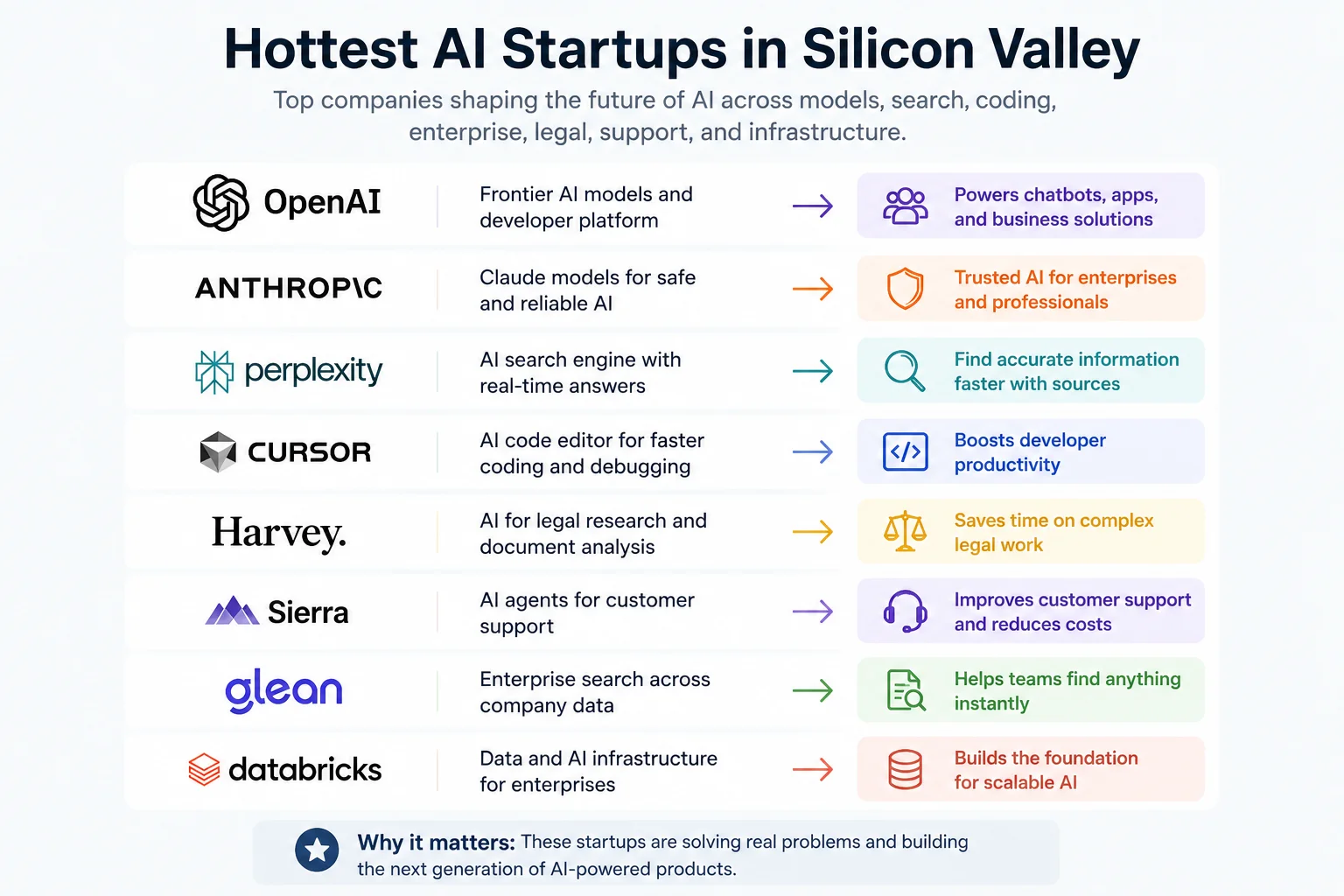
1. OpenAI
OpenAI remains one of the most influential AI companies in the world. Its models, ChatGPT ecosystem, developer tools, and enterprise products helped define the modern generative AI market.
Why it matters: OpenAI is not just a chatbot company. It is building a platform for developers, businesses, content creation, coding, automation, and AI agents.
2. Anthropic
Anthropic is known for Claude, a family of AI models focused on helpfulness, reliability, and safety. It has become especially popular among professionals who need strong reasoning, writing, coding, and enterprise-grade AI support.
Why it matters: Anthropic is one of the strongest competitors in the frontier AI model race, especially for businesses that care about safety and controlled deployment.
3. Perplexity AI
Perplexity is trying to reinvent search. Instead of giving users a list of blue links, it provides direct answers with cited sources. This makes it attractive for research, learning, market analysis, and fast information discovery.
Why it matters: If AI search continues growing, Perplexity could become one of the biggest challenges to traditional search engines.
4. Cursor by Anysphere
Cursor has become one of the most talked-about AI coding tools. It helps developers write, edit, debug, and understand code faster inside an AI-native code editor.
Why it matters: Software development is one of the clearest areas where AI can save time immediately. Cursor is popular because it fits directly into developers’ daily workflow.
5. Harvey
Harvey focuses on AI for legal and professional services. It helps with legal research, due diligence, contract analysis, document review, and complex legal workflows.
Why it matters: Legal work is expensive, document-heavy, and time-sensitive. That makes it a strong market for specialized AI tools.
6. Sierra
Sierra builds AI agents for customer service. Instead of simple chatbots, Sierra focuses on AI systems that can handle customer conversations, solve problems, and support brands at scale.
Why it matters: Customer support is one of the first business areas where AI agents can show measurable value.
7. Glean
Glean focuses on enterprise search and workplace AI. It helps employees find information across company tools, documents, messages, and internal knowledge systems.
Why it matters: Most companies do not have an AI problem first. They have a knowledge-access problem. Glean solves that by connecting workplace data with AI-powered search and assistants.
8. Databricks
Databricks is not a tiny startup anymore, but it remains a major private AI and data company in the Bay Area. It helps businesses manage data, analytics, machine learning, and AI development.
Why it matters: AI is only as useful as the data behind it. Databricks sits close to the foundation of enterprise AI adoption.
Comparison Table: Top Silicon Valley AI Startups
| Startup | Main Focus | Best Known For | Why It Is Hot |
| OpenAI | Frontier AI models | ChatGPT, developer tools | Massive platform influence |
| Anthropic | AI safety and Claude models | Claude | Strong enterprise trust |
| Perplexity | AI search | Answer engine | Challenges traditional search |
| Cursor | AI coding | AI-native code editor | Huge developer appeal |
| Harvey | Legal AI | Legal workflows | Clear professional use case |
| Sierra | Customer service AI | AI agents | Strong business automation angle |
| Glean | Enterprise AI search | Workplace knowledge assistant | Solves internal company search |
| Databricks | Data and AI infrastructure | Data intelligence platform | Powers enterprise AI systems |
Key Trends Behind the Hype
The hottest ai startups in silicon valley are not all doing the same thing. The market is splitting into clear categories:
- Foundation model companies building powerful general AI systems
- AI coding startups helping developers ship faster
- Vertical AI companies serving legal, healthcare, finance, and customer service
- Enterprise AI platforms connecting internal company knowledge
- AI infrastructure startups solving compute, data, and deployment problems
This shift is important. The next AI winners may not be the companies with the loudest demos. They may be the ones with the clearest business value.
Step-by-Step Guide: How to Evaluate an AI Startup
Step 1: Check the Problem
Ask one simple question: does this startup solve a painful problem, or is it just an impressive demo?
Step 2: Look at the Target Market
A strong AI startup usually targets a market with high costs, repetitive work, or information overload.
Step 3: Study Product Adoption
Look for signs that real users are adopting the product. Developer usage, enterprise customers, and recurring revenue matter more than hype.
Step 4: Review the Business Model
A startup needs a clear way to make money. Free AI tools can grow fast, but compute costs can destroy margins.
Step 5: Watch the Competition
If Google, Microsoft, OpenAI, or Anthropic can easily copy the product, the startup needs a strong moat.
Read More: Toum AI
Pros and Cons of Following Silicon Valley AI Startups
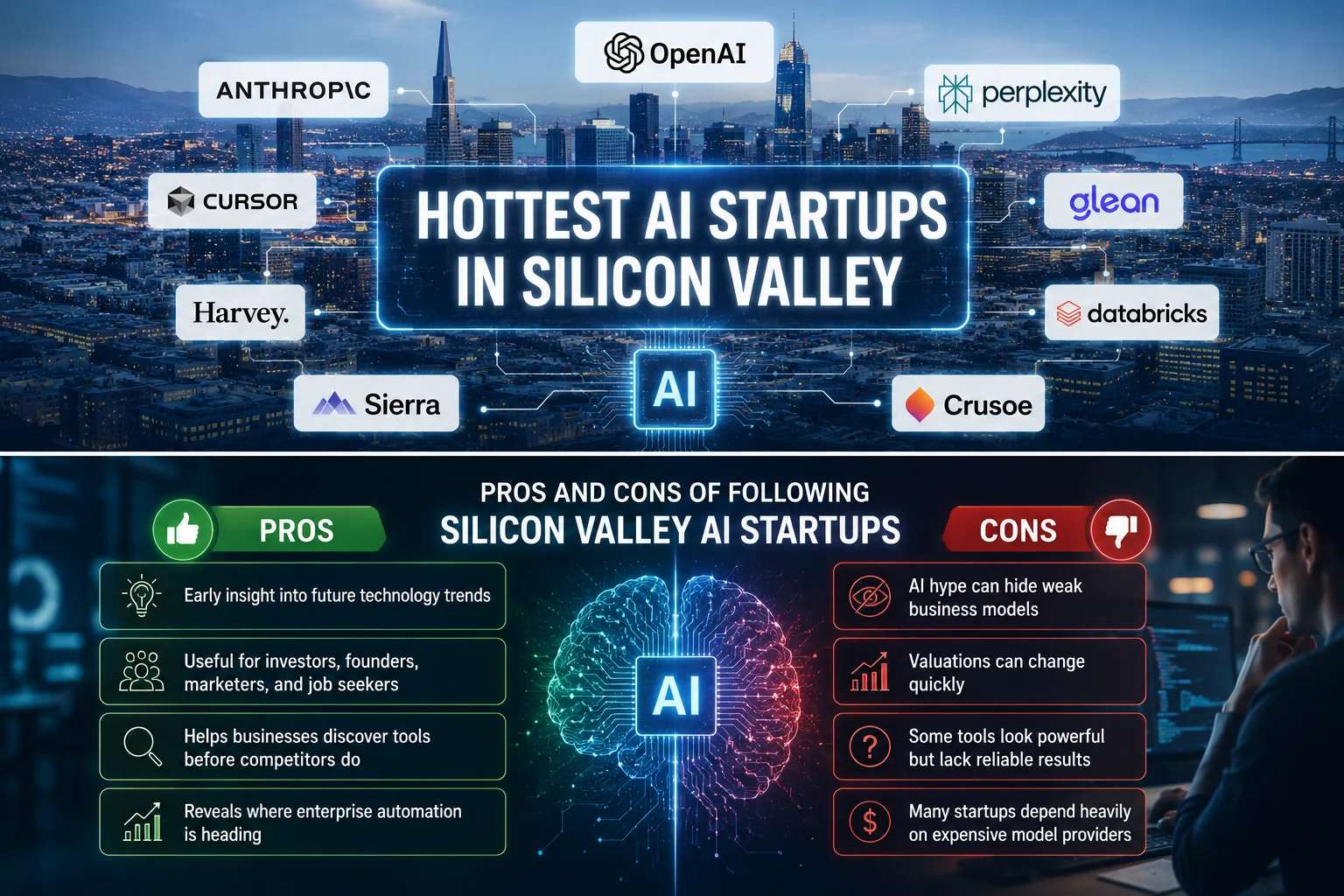
Pros
- Early insight into future technology trends
- Useful for investors, founders, marketers, and job seekers
- Helps businesses discover tools before competitors do
- Reveals where enterprise automation is heading
Cons
- AI hype can hide weak business models
- Valuations can change quickly
- Some tools look powerful but lack reliable results
- Many startups depend heavily on expensive model providers
Who Should Track These AI Startups?
This topic is useful for:
- Entrepreneurs looking for startup ideas
- Investors studying emerging AI categories
- Developers choosing tools and career paths
- Business owners exploring automation
- SEO and content professionals watching AI search trends
- Students learning where AI jobs may grow
Final Verdict
The hottest ai startups in silicon valley are not just building chatbots. They are building the next layer of software: AI agents, AI search, legal automation, coding assistants, workplace intelligence, and data infrastructure.
OpenAI and Anthropic dominate the frontier model conversation. Perplexity is pushing AI search forward. Cursor is reshaping software development. Harvey, Sierra, and Glean show how vertical and enterprise AI can create real business value.
The honest truth is simple: not every hyped AI startup will survive. The winners will be the companies that turn AI from a cool feature into a daily business necessity.
FAQs
1. What are the hottest AI startups in Silicon Valley?
Some of the most watched AI startups include OpenAI, Anthropic, Perplexity, Cursor, Harvey, Sierra, Glean, and Databricks.
2. Why are so many AI startups based in Silicon Valley?
Silicon Valley offers strong access to engineers, investors, enterprise customers, cloud partners, and startup networks.
3. Is OpenAI still considered a startup?
OpenAI is a large private AI company, but it is still commonly discussed in startup and venture-backed technology circles.
4. Which AI startup is best for developers?
Cursor is one of the most popular AI tools for developers because it focuses directly on coding, debugging, and editing software.
5. Are AI startups overhyped?
Some are overhyped, yes. The smart way to judge them is by product adoption, revenue quality, customer retention, and whether the product solves a real problem.

Charles Brook is the Founder of Vantiro Media and a University of Nairobi (B.Com) graduate. As a business software specialist, he helps Kenyan SMEs navigate eTIMS compliance, compare tools like QuickBooks, Zoho, & Sage, and choose the best budget-friendly accounting systems.