
Choosing the best accounting software for small businesses in Kenya is not just about picking a popular tool. A business in Kenya needs more than normal invoicing. It may also need eTIMS support, VAT records, expense tracking, inventory control, cash flow reports, and accountant access.
This is where many small businesses make the wrong decision. They choose software because it looks cheap or popular, then later discover that it does not fit their tax invoicing workflow, reporting needs, or business size.
The right accounting software should make your work easier. It should help you record sales, send invoices, track expenses, understand profit, and prepare useful reports. If your business needs electronic tax invoices, you must also check how the software works with eTIMS.
For a clear guide on eTIMS itself, you can read this detailed article: What Is eTIMS in Kenya?
How We Compared the Best Accounting Software for Small Businesses in Kenya
This guide does not rank software based on fake reviews or invented ratings. Instead, it compares tools based on what Kenyan small businesses usually need.
We looked at:
- Kenya relevance
- eTIMS clarity
- Invoicing features
- VAT support
- Expense tracking
- Financial reports
- Inventory support
- Accountant access
- Ease of use
- Business size suitability
- Official source information
If a feature is not confirmed by an official source, this article clearly says: Not clearly mentioned by the official source.
That matters because accounting software is not something you should choose based on guesswork.
Why eTIMS Matters Before Choosing Accounting Software in Kenya
For businesses in Kenya, eTIMS is a serious factor. eTIMS stands for electronic Tax Invoice Management System. It is used for electronic tax invoicing in Kenya.
Before choosing accounting software, you should check whether the software supports eTIMS directly, works through an approved integrator, or needs a separate workflow.
You can also check the official KRA eTIMS guidance before choosing any accounting platform.
If your business needs eTIMS-compliant invoices, do not assume every global accounting tool will handle this automatically.
Before paying for software, ask:
- Does this software support eTIMS?
- Is eTIMS built into the software?
- Does it use an approved integrator?
- Can invoices be pushed to KRA?
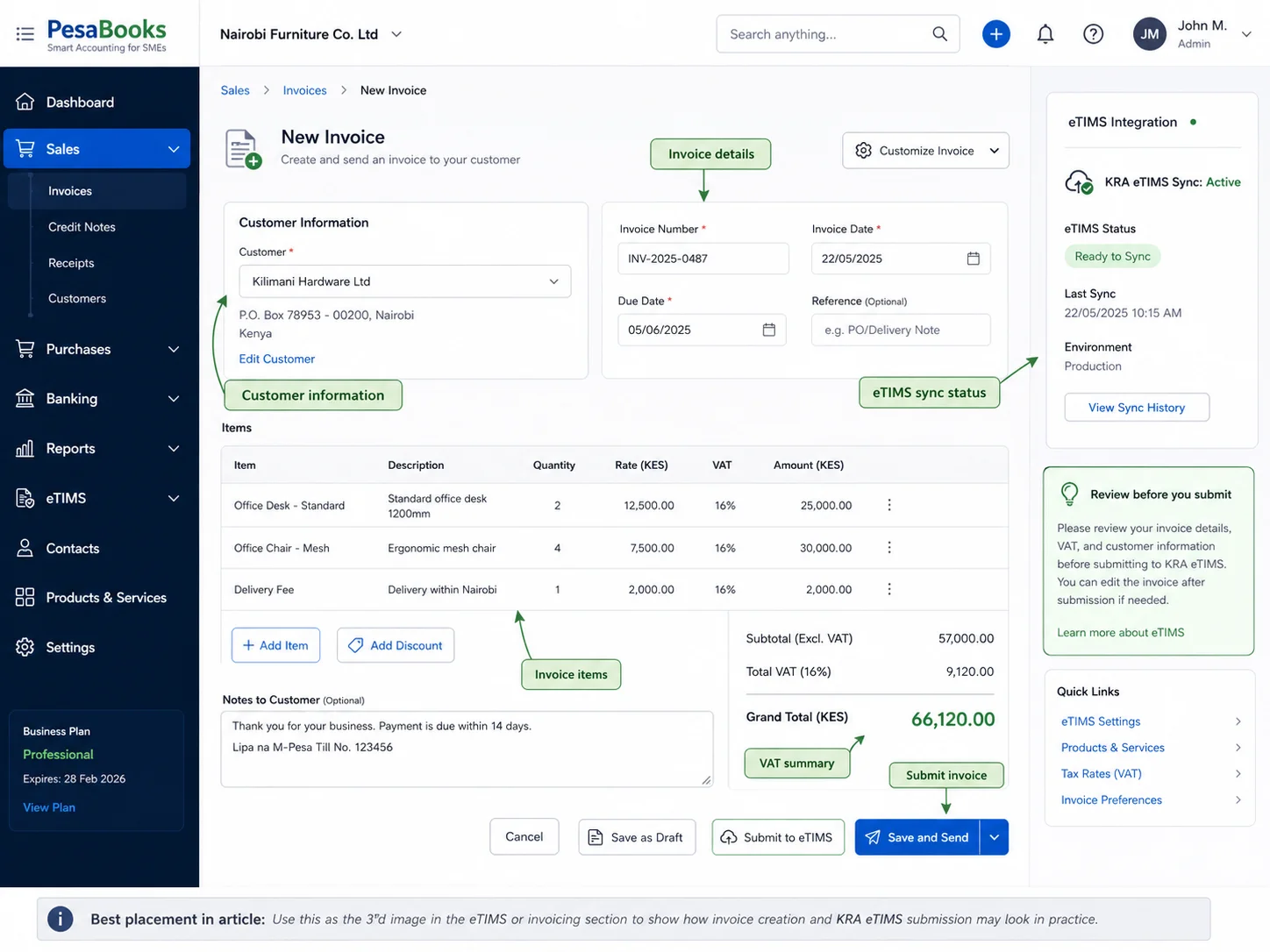
Example invoice screen showing how VAT details and eTIMS submission may appear in accounting software. - Does it support VAT invoices?
- Is eTIMS included in the plan?
- Can the provider show a real invoice demo?
- Can your accountant use the reports?
If you need a dedicated guide on this topic, read: eTIMS Compliant Accounting Software in Kenya
Quick Comparison Table
| Software | Best For | eTIMS Status from Official Source | Good Fit For |
| Zoho Books | Kenya-focused accounting and eTIMS support | Clearly mentioned by official source | SMEs, shops, online sellers, agencies, consultants |
| QuickBooks Online | General accounting and strong reporting | Not clearly mentioned by the official source | SMEs with accountant support |
| Sage Accounting | Cloud accounting and business finance tools | Not clearly mentioned by the official source | SMEs and growing service businesses |
| Xero | Cloud accounting and app integrations | Not clearly mentioned by the official source | Growing businesses and accountant-led setups |
| FreshBooks | Simple invoicing and service billing | Not clearly mentioned by the official source | Freelancers, consultants, agencies |
1. Zoho Books
Zoho Books is one of the strongest options to check first when looking for the best accounting software for small businesses in Kenya.
The main reason is simple: Zoho Books has Kenya-focused accounting pages and officially mentions eTIMS-compliant accounting. Its official eTIMS page also says Zoho Books is a KRA-approved eTIMS integrator.
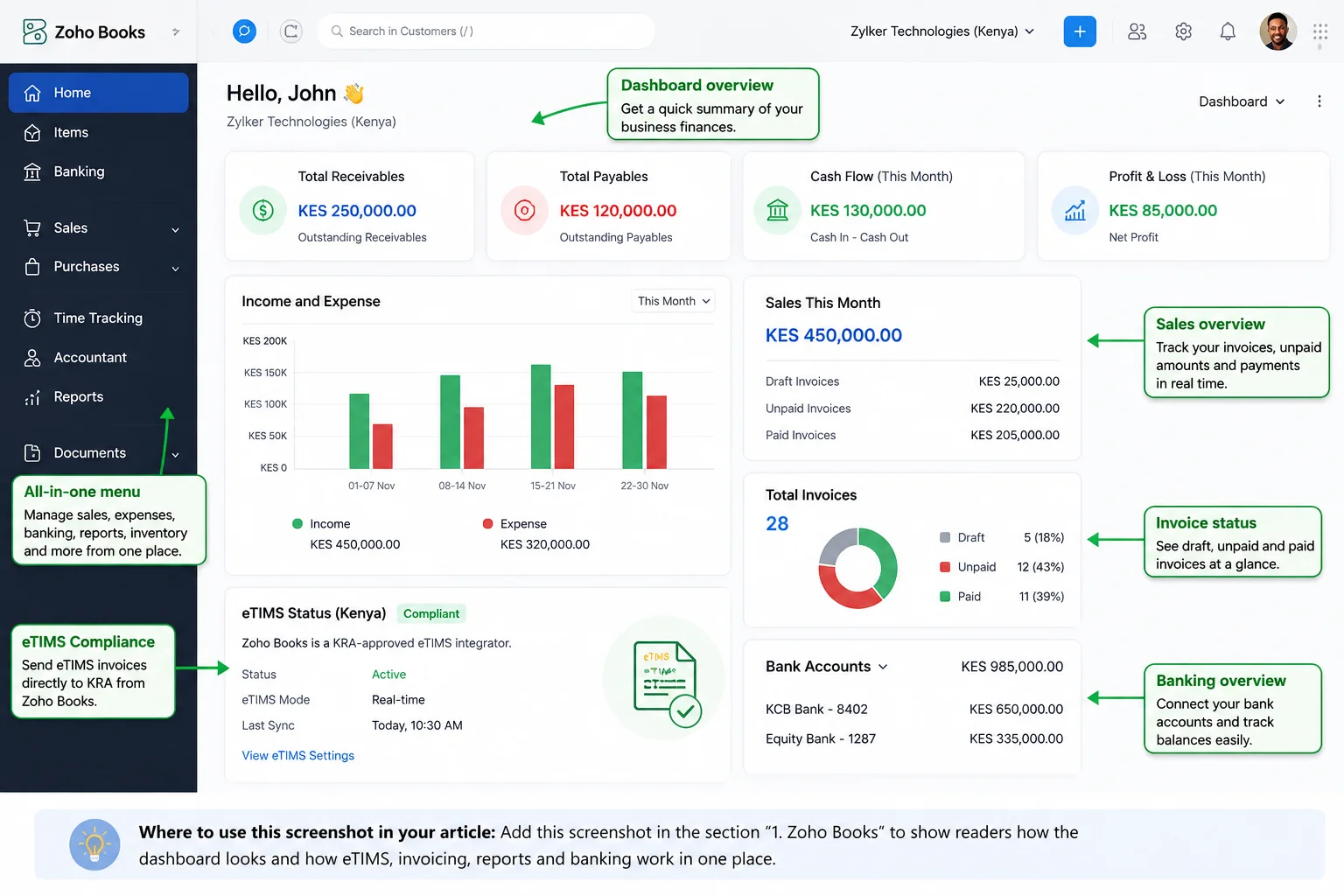
You can check the official Zoho page here: Zoho Books eTIMS compliance
This makes Zoho Books more relevant for Kenyan businesses than many global accounting tools that do not clearly mention Kenya eTIMS support.
Key Features
Zoho Books can help with:
- Invoicing
- eTIMS-related invoicing
- VAT handling
- Expense tracking
- Inventory tracking
- Customer and vendor management
- Reports
- Cash flow tracking
- Automation
- Mobile access
- Accountant collaboration
Why Zoho Books May Suit Kenyan Small Businesses
Zoho Books may be useful for businesses that need accounting software with Kenya-specific support.
It can suit:
- Retail shops
- Online sellers
- Consultants
- Small agencies
- Service businesses
- SMEs with inventory
- VAT-registered businesses
- Businesses that need accountant access
Pros
- Kenya-specific accounting support is clearly presented
- eTIMS-compliant accounting is officially mentioned
- KRA-approved eTIMS integrator status is officially mentioned
- Useful for VAT-related records
- Supports invoices, expenses, inventory, and reports
- Suitable for many small business types
- Cloud-based access
Cons
- Some features may depend on the selected plan
- New users may need setup help
- Inventory and tax settings should be configured carefully
- Businesses should confirm current pricing before subscribing
Things to Check Before Using Zoho Books
Before choosing Zoho Books, check:
- Which plan includes the features you need
- Whether eTIMS setup is included or needs configuration
- Whether your accountant can use it
- Whether your business needs inventory tracking
- Whether the invoicing workflow matches your business
- Whether support is available when you need help
2. QuickBooks Online
QuickBooks Online is a popular cloud accounting software used by many small businesses globally. It is known for invoicing, expense tracking, reports, bank feeds, tax tracking, inventory, receipt capture, and accountant tools.
For Kenyan businesses, QuickBooks may be useful if your accountant already works with it or if your business needs strong general accounting and reporting.
However, there is one important warning: eTIMS support is not clearly mentioned by the official source.
That does not automatically mean QuickBooks cannot be used in Kenya. It means you should not assume it is eTIMS-ready without checking your exact workflow.
Key Features
QuickBooks Online can help with:
- Invoicing
- Expense tracking
- Bank feeds
- Tax tracking
- Inventory
- Receipt capture
- Reports
- Mobile access
- Accountant tools
Why QuickBooks May Suit Some Kenyan Businesses
QuickBooks may suit businesses that want a mature accounting system and already work with an accountant who understands it.
It can be useful for:
- Service businesses
- SMEs
- Agencies
- Businesses with regular expenses
- Businesses that need detailed reports
- Businesses that use other apps connected to QuickBooks
Pros
- Strong general accounting features
- Good reporting tools
- Useful for accountants and bookkeepers
- Supports invoicing, expenses, and inventory
- Cloud-based access
- Integrates with many third-party apps
Cons
- eTIMS workflow should be confirmed before use
- Kenya-specific tax setup may need accountant help
- Some features may depend on the plan
- It may be too much for very small businesses
- Wrong setup can create confusing reports
Things to Check Before Using QuickBooks Online
Before choosing QuickBooks in Kenya, check:
- Whether your accountant supports QuickBooks
- Whether eTIMS can be handled through an approved process
- Whether your invoice records meet your business needs
- Whether bank feeds work for your bank
- Whether the plan includes inventory, users, and reports
- Whether local support is available
3. Sage Accounting
Sage Accounting is another accounting software option for small businesses and growing companies. Sage has a Kenya website and offers accounting software for businesses that want to manage invoicing, cash flow, tax, payments, and business finance records.
Sage may suit businesses that want structured accounting software from an established business software provider.
Key Features
Sage Accounting can help with:
- Invoicing
- Cash flow management
- Expense records
- Business finance tracking
- Accounting reports
- Tax-related records
- Accountant collaboration
- Cloud accounting
Kenya / eTIMS Note
Users should verify current eTIMS compatibility directly with the provider.
If your business needs eTIMS, confirm this directly before subscribing. Ask whether Sage supports eTIMS directly, through a local partner, or through a separate workflow.
Why Sage May Suit Some Kenyan Businesses
Sage may be a good choice for businesses that want a more traditional accounting system and need structured financial records.
It may suit:
- SMEs
- Service companies
- Professional businesses
- Growing businesses with regular bookkeeping needs
- Businesses that already use Sage products
Pros
- Established accounting and business software provider
- Kenya website is available
- Useful for small and medium businesses
- Helps reduce manual accounting work
- Can support accountant collaboration
Cons
- Confirm eTIMS setup with Sage or a local partner
- Setup may require accountant or partner support
- Some users may find it less beginner-friendly
- Plan details should be checked carefully before buying
Things to Check Before Using Sage Accounting
Before choosing Sage Accounting, check:
- Whether eTIMS is supported
- Whether your accountant can work with Sage
- Whether the plan fits your business size
- Whether support is available in Kenya
- Whether the system handles your invoicing needs
- Whether reports are enough for your business
4. Xero
Xero is a cloud accounting platform used by small businesses, accountants, and bookkeepers. It focuses on online accounting, invoices, bills, reports, cash flow, bank connections, and app integrations.
Xero may be useful for businesses that want clean cloud accounting and already work closely with an accountant.
Key Features
Xero can help with:
- Online invoicing
- Bills
- Business reports
- Cash flow visibility
- Bank connections, depending on region and bank
- Accountant collaboration
- App integrations
- Cloud access
Kenya / eTIMS Note
Official documentation does not clearly confirm eTIMS support.
If you want to use Xero in Kenya, confirm how eTIMS will be handled. You may need an accountant, a third-party connector, or a separate eTIMS process.
Why Xero May Suit Some Kenyan Businesses
Xero may suit businesses that need cloud accounting and app integrations. It can be a good option for businesses that already have proper bookkeeping processes.
It may fit:
- Agencies
- Service businesses
- Growing SMEs
- Accountant-managed businesses
- Businesses that use multiple apps
Pros
- Clean cloud accounting platform
- Good for accountant collaboration
- Useful reporting features
- Strong app integration ecosystem
- Suitable for growing businesses
Cons
- Kenya eTIMS handling should be verified separately
- Kenya-specific setup may need expert help
- Bank connection support should be checked for Kenyan banks
- Some features may depend on the plan
Things to Check Before Using Xero
Before choosing Xero, check:
- Whether your accountant supports Xero
- Whether eTIMS can be handled properly
- Whether your bank is supported
- Whether the plan includes the features you need
- Whether reports match your business needs
- Whether app integrations are useful for your workflow
5. FreshBooks
FreshBooks is a simple accounting and invoicing software option. It is especially useful for freelancers, consultants, agencies, and service businesses.
FreshBooks focuses on invoicing, expenses, time tracking, clients, estimates, proposals, payments, reports, and mobile access.
It may be easier for service-based businesses than heavier accounting systems.
Key Features
FreshBooks can help with:
- Professional invoices
- Expense tracking
- Time tracking
- Estimates
- Proposals
- Client records
- Reports
- Mobile access
- Billing and payment workflows, depending on region
Kenya / eTIMS Note
Businesses should confirm eTIMS workflows before subscribing.
FreshBooks may help with normal invoicing and client billing, but Kenyan businesses should confirm how they will handle eTIMS before using it as their main accounting system.
Why FreshBooks May Suit Freelancers and Service Businesses
FreshBooks is better for businesses that bill clients for services, projects, or time.
It may suit:
- Freelancers
- Consultants
- Designers
- Marketing agencies
- Small service teams
- Professionals who bill clients by project or hour
Pros
- Simple and easy to understand
- Strong invoicing features
- Useful time tracking
- Good for client-based businesses
- Helpful for estimates and proposals
- Mobile-friendly
Cons
- Check the eTIMS process before using it for tax invoices
- May not be ideal for inventory-heavy businesses
- Payment features may depend on region
- Growing SMEs may need more advanced accounting later
Things to Check Before Using FreshBooks
Before choosing FreshBooks, check:
- Whether it fits your tax invoicing process
- Whether eTIMS can be handled properly
- Whether your accountant can use the reports
- Whether you need inventory features
- Whether payment options work for Kenya
- Whether the plan supports your number of clients and users
Best Accounting Software for Small Businesses in Kenya by Business Type
The best software depends on your business model. A freelancer does not need the same features as a retail shop. A VAT-registered company does not need the same setup as a very small service business.
Best for Kenya eTIMS Needs
Zoho Books should be checked first because its official Kenya pages clearly mention eTIMS-compliant accounting and KRA-approved eTIMS integrator status.
Best for Businesses With Accountant Support
QuickBooks Online, Sage Accounting, and Xero may work well if your accountant already supports them and your eTIMS process is clearly handled.
Best for Freelancers and Consultants
FreshBooks may be useful for freelancers and service providers who need simple invoicing, expense tracking, and time tracking.
Best for Inventory-Based Businesses
Zoho Books, QuickBooks Online, Sage, or Xero may be better to check than FreshBooks if your business sells products and needs stock tracking.
For more accounting and audit tool comparisons, you can also read: Common Account Audit Software Used in Kenya
Pros and Cons of Accounting Software for Small Businesses in Kenya
Pros
Accounting software can help Kenyan small businesses:
- Save time on bookkeeping
- Reduce manual invoice mistakes
- Track income and expenses
- See unpaid invoices
- Improve cash flow control
- Prepare useful reports
- Work better with accountants
- Keep VAT records organized
- Manage inventory, if supported
- Export records when needed
Cons
Accounting software can also create problems if chosen carelessly:
- Monthly costs can increase
- Some features may only be available on higher plans
- eTIMS may not be supported by default
- Setup mistakes can create wrong reports
- Staff may need training
- Data migration can be difficult
- Some tools may not fully match Kenyan business needs
Things to Check Before Using Accounting Software in Kenya
Before paying for any accounting software, check these points carefully.
1. eTIMS Support
This is the biggest check for businesses in Kenya.
Ask the provider:
- Do you support eTIMS?
- Are you a KRA-approved integrator?
- Can invoices be pushed to eTIMS?
- Is eTIMS included in this plan?
- Can you show a live demo?
If the answer is unclear, do not rush.
2. VAT Support
If your business is VAT-registered, check whether the software supports VAT invoices and VAT reports.
Do not assume this. Ask clearly.
3. Kenyan Shilling Support
The software should support Kenyan Shilling properly. If you sell outside Kenya, also check multi-currency support.
4. M-Pesa and Bank Records
Many Kenyan businesses receive payments through M-Pesa, bank transfers, card payments, or cash.
Check how the software records these payments. If M-Pesa integration is not clearly mentioned by the official source, ask the provider before buying.
5. Inventory Management
If you sell products, inventory tracking matters.
Check whether the software can track:
- Stock levels
- Purchases
- Sales
- Product costs
- Stock movement
- Inventory reports
A service business may not need advanced inventory, but a shop or online seller usually does.
6. Accountant Access
Your accountant should not need your personal login. Choose software that allows controlled user access.
7. Reports
Good accounting software should provide useful reports, such as:
- Profit and loss
- Balance sheet
- Cash flow
- Sales reports
- Expense reports
- Tax reports
- Accounts receivable
- Accounts payable
8. Data Export
You should be able to export your data. This matters if you change software later or need records for your accountant.
9. Pricing and Plan Limits
Do not look only at the starting price.
Check:
- Number of users
- Number of invoices
- Customer limits
- Inventory access
- eTIMS features
- Multi-currency
- Support level
- Add-on costs
10. Ease of Use
The best software is not always the one with the most features. It is the one your business can use correctly every day.
Best Alternatives to Full Accounting Software
Some businesses may not need full accounting software immediately. Here are practical alternatives.
KRA eTIMS Tools Plus Spreadsheets
Very small businesses may use eTIMS tools with spreadsheets for basic tracking.
This can work in the beginning, but it becomes difficult when sales, expenses, customers, and stock increase.
Accountant-Managed Bookkeeping
Some small businesses prefer to let their accountant manage accounting software.
This can work if the accountant gives regular reports. The downside is that the business owner may not see cash flow clearly during the month.
POS System With Accounting Features
Retail shops, restaurants, wholesalers, and supermarkets may need a POS system that connects with accounting or eTIMS.
Before choosing a POS system, check whether it supports eTIMS and whether reports are useful for your accountant.
ERP Software
Growing businesses with inventory, staff, branches, suppliers, and complex operations may need ERP software instead of basic accounting software.
ERP is usually more expensive and needs proper setup.
Final Verdict
The best accounting software for small businesses in Kenya depends on your business type, tax needs, budget, and daily workflow.
If eTIMS support is your top concern, Zoho Books should be checked first because its official Kenya pages clearly mention eTIMS-compliant accounting and KRA-approved eTIMS integrator status.
QuickBooks Online, Sage Accounting, Xero, and FreshBooks can also be useful, but their official sources do not clearly mention Kenya eTIMS support. That means you should confirm eTIMS handling before using them as your main accounting system.
The right accounting software should help you invoice correctly, track money clearly, manage records properly, and work smoothly with your accountant.
Do not buy accounting software only because someone calls it the best. Ask for a demo, test one invoice, check eTIMS, review reports, and confirm that it fits your actual business.
FAQs
1. What is the best accounting software for small businesses in Kenya?
- Zoho Books is one of the strongest options to check first because its official Kenya pages clearly mention eTIMS-compliant accounting and KRA-approved eTIMS integrator status. However, the best choice depends on your business type, budget, VAT needs, inventory needs, and accountant support.
2. Does accounting software in Kenya need eTIMS support?
- Yes, eTIMS is an important factor for Kenyan businesses. Before using any accounting software, check whether it supports eTIMS directly or through an approved process.
3. Is Zoho Books good for small businesses in Kenya?
- Zoho Books is worth checking because its official Kenya page mentions eTIMS-compliant accounting, invoicing, VAT-related features, inventory, reports, and automation.
4. Is QuickBooks good for businesses in Kenya?
- QuickBooks Online can be useful for general accounting, invoicing, expenses, reports, and inventory. However, eTIMS support is not clearly mentioned by the official source, so Kenyan businesses should verify eTIMS handling before using it.
5. Is Sage Accounting suitable for Kenyan SMEs?
- Sage Accounting may suit SMEs that need cloud accounting and business finance tools. However, The official source does not provide clear details about eTIMS support., so businesses should confirm this before subscribing.
6. Can freelancers in Kenya use FreshBooks?
- FreshBooks may be useful for freelancers and consultants because it supports invoicing, expenses, time tracking, estimates, and client billing. However, eTIMS availability should be verified through official channels.
7. Can I use Excel instead of accounting software?
- Excel can work for very small businesses, but it becomes difficult as transactions grow. It does not automatically handle eTIMS, VAT reports, inventory, accountant access, or financial reporting unless you manage everything manually.
8. What should I check before buying accounting software in Kenya?
- Check eTIMS support, VAT handling, Kenyan Shilling support, M-Pesa or bank payment recording, inventory, reports, accountant access, data export, pricing, support, and ease of use.
9. Is free accounting software enough for a small business in Kenya?
- Free software may be enough for basic records, but it may not support eTIMS, VAT, inventory, reports, or accountant workflows. Always check the limits before depending on a free tool.
10. Should I ask my accountant before choosing accounting software?
- Yes. Your accountant can help you avoid setup mistakes and confirm whether the software gives the reports needed for tax and business decisions.

Charles Brook is the Founder of Vantiro Media and a University of Nairobi (B.Com) graduate. As a business software specialist, he helps Kenyan SMEs navigate eTIMS compliance, compare tools like QuickBooks, Zoho, & Sage, and choose the best budget-friendly accounting systems.
Kenya SME Software Brief
Need Help Choosing Accounting Software in Kenya?
Get simple buying tips, eTIMS guidance, VAT record advice, pricing comparisons, and software recommendations for Kenyan SMEs.
- eTIMS tips
- VAT records
- Pricing guides
- Software comparisons
No spam. Just useful Kenya business software updates and simple accounting guides.
Free Checklist