
Updated: June 2026
Reviewed for: Kenyan SMEs, startups, consultants, retailers, and growing businesses
QuickBooks vs Sage vs Zoho Books in Kenya: Quick Answer
If you are comparing QuickBooks vs Sage vs Zoho Books in Kenya, here is the direct answer.
For most small and medium businesses in Kenya, Zoho Books is the best starting choice because it is affordable, easy to use, supports VAT workflows, and offers eTIMS-focused invoicing features on paid plans.
QuickBooks is a strong option if your accountant already uses it or if you want a globally recognized accounting system with solid reporting.
Sage is better for established businesses that need stronger finance controls, payroll options, and advanced business management tools.
So, the real question is not “Which software is famous?”
The real question is: which one fits your business size, tax needs, budget, and daily workflow?
If you are still comparing broader options, you can also read this guide on best accounting software for small businesses in Kenya before making your final decision.
Why Kenyan Businesses Need Accounting Software Now
Running a business in Kenya without proper accounting software is risky.
You may survive with Excel for a while, but as invoices, expenses, taxes, stock, and payments increase, manual bookkeeping becomes messy. Mistakes start happening. Receipts disappear. Cash flow becomes unclear. And when tax season comes, everything becomes stressful.
A good cloud accounting software in Kenya helps you:
- Create professional invoices
- Track sales and expenses
- Manage VAT records
- Prepare financial reports
- Reconcile bank transactions
- Monitor inventory
- Share access with your accountant
- Reduce manual errors
- Understand profit and cash flow faster
Even better, modern accounting tools help businesses stay ready for Kenya’s digital tax environment, including electronic invoicing requirements. According to the KRA official eTIMS page, businesses are required to onboard eTIMS and issue electronic tax invoices.
If you are not clear about this system yet, start with this simple guide on what is eTIMS in Kenya.
Quick Comparison Table: QuickBooks vs Sage vs Zoho Books
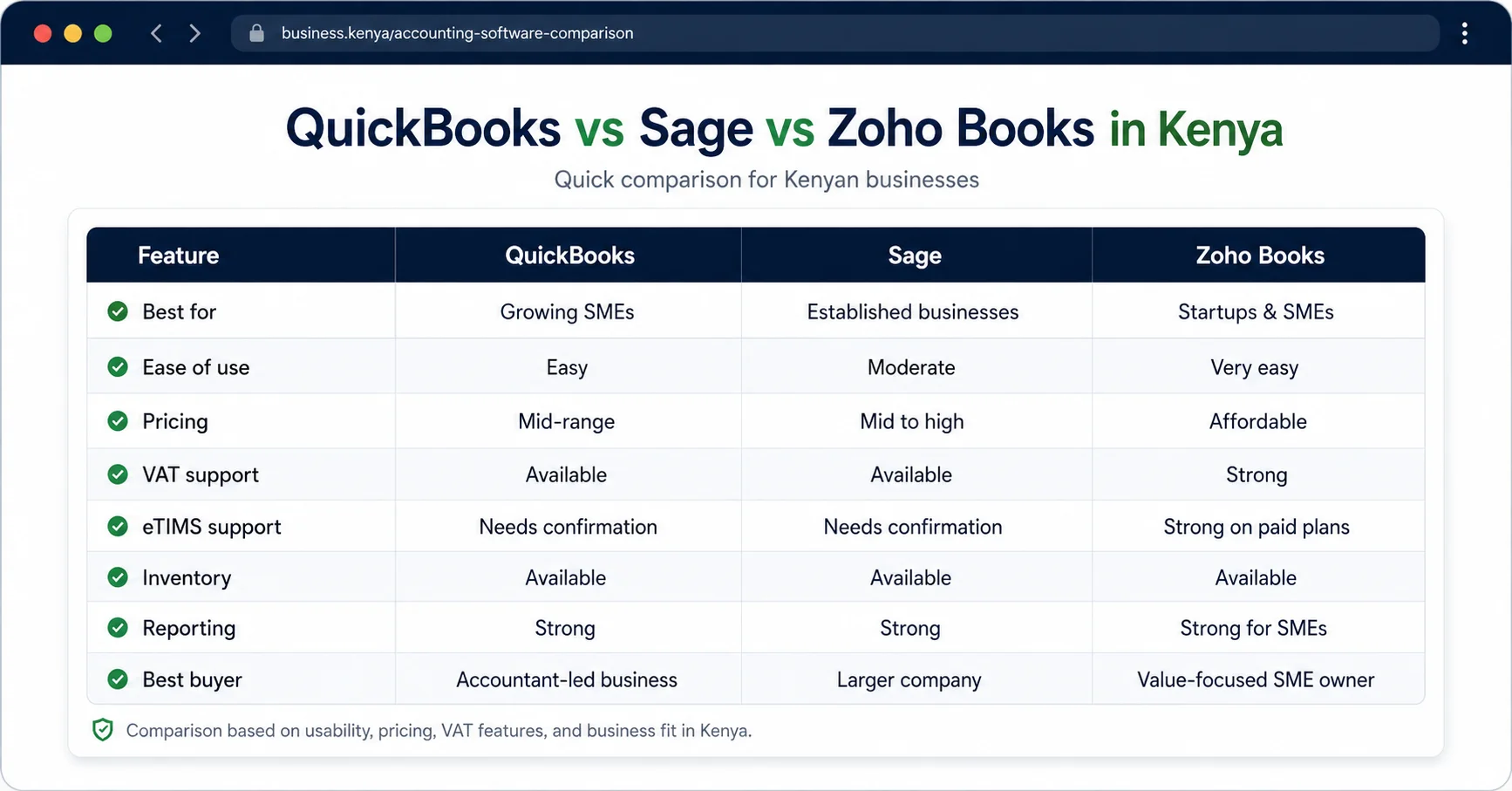
| Feature | QuickBooks | Sage | Zoho Books |
|---|---|---|---|
| Best for | Growing SMEs and accountant-led businesses | Established and larger businesses | Startups, SMEs, consultants, retailers |
| Ease of use | Easy | Medium | Very easy |
| Pricing style | Subscription-based | Subscription-based | Free and paid KSh plans |
| VAT support | Available | Available | Strong VAT features |
| eTIMS focus | Needs setup confirmation | Needs setup confirmation | Strong eTIMS-focused features |
| Inventory | Available | Available | Available |
| Reporting | Strong | Strong | Strong for SMEs |
| Best buyer | Business with accountant support | Larger company | SME owner who wants value |
QuickBooks in Kenya: Best for Accountant-Friendly Accounting
QuickBooks in Kenya is a popular choice for businesses that want simple invoicing, expense tracking, financial reports, and accountant collaboration.
It is especially useful if your accountant already understands QuickBooks. That alone can save time during setup, monthly reviews, and tax preparation.
Key Features of QuickBooks
QuickBooks helps with:
- Sales invoices
- Expense tracking
- Cash flow monitoring
- Financial reports
- Tax preparation support
- Inventory management
- Business app integrations
- Cloud access
The dashboard is clean, and the reporting is useful for business owners who want to see profit, expenses, unpaid invoices, and overall performance.
Who Should Choose QuickBooks?
Choose QuickBooks accounting software if:
- Your accountant already works with QuickBooks
- You want strong reporting
- You need cloud-based bookkeeping
- You want easy invoice and expense management
- You prefer a globally known accounting platform
Who Should Avoid QuickBooks?
Avoid QuickBooks if your main priority is the lowest local pricing or Kenya-specific eTIMS setup without extra checking.
QuickBooks is good, but Kenyan businesses should confirm the exact VAT and electronic invoicing workflow before subscribing.
Sage in Kenya: Best for Established Businesses
Sage in Kenya is a serious accounting and business management option. It is not just for small businesses. Sage is often better for companies that need more structure, stronger controls, and room to scale.
If your business is growing beyond simple invoicing, Sage can make sense.
Key Features of Sage
Sage accounting software helps businesses manage:
- Invoicing
- Cash flow
- Tax records
- Payments
- Business reports
- Finance processes
- Multi-user accounting workflows
Sage can also connect with broader business solutions, depending on the product and setup.
For businesses that also need audit-related tools, this guide on common accounting and audit software used in Kenya may help you compare options beyond daily bookkeeping.
Who Should Choose Sage?
Choose Sage accounting software in Kenya if:
- Your business is already established
- You have multiple staff handling finance
- You need better control over approvals and reporting
- You may need payroll or enterprise tools later
- You want a system built for structured business growth
Who Should Avoid Sage?
Avoid Sage if you are a small startup with basic bookkeeping needs.
Sage is powerful, but for a new business owner who only needs invoices, expenses, VAT tracking, and simple reports, it may feel heavier than necessary.
Zoho Books in Kenya: Best Value for SMEs
For most Kenyan SMEs, Zoho Books in Kenya is the strongest choice.
Why?
Because it gives small businesses what they actually need: affordable pricing, clean invoices, VAT tracking, reports, bank feeds, inventory, automation, customer portal, and eTIMS-focused invoicing features on paid plans.
Zoho also has an official Kenya page explaining how businesses can enable eTIMS features inside Zoho Books. You can review the Zoho Books eTIMS compliance page for more details.
That makes it practical for businesses that want control without paying for enterprise-level software.
Key Features of Zoho Books
Zoho Books accounting software includes:
- Invoices and quotes
- Expenses and journals
- Vendor bills
- VAT tracking
- VAT3 reports
- Bank feeds
- Bank reconciliation
- Inventory tracking
- Recurring invoices
- Payment reminders
- Customer portal
- Purchase orders
- Multi-currency features on higher plans
- Workflow automation
- Project profitability on selected plans
For a Kenyan business, this mix is strong. You are not only getting bookkeeping. You are getting a system that helps you run the daily money side of your business properly.
If eTIMS is your main concern, you should also read this detailed guide on eTIMS-compliant accounting software in Kenya.
Who Should Choose Zoho Books?
Choose Zoho Books Kenya if:
- You run a small or medium business
- You want affordable cloud accounting
- You need VAT tracking
- You want eTIMS-focused invoicing features
- You sell products or services
- You need inventory and reports
- You want something easy for daily use
This is why Zoho Books is the best recommendation for most Kenyan SMEs.
Step-by-Step Guide: How to Choose the Right Accounting Software in Kenya
Step 1: Look at Your Business Size
If you are a freelancer, consultant, small shop, agency, or online seller, start with Zoho Books.
If you are a growing SME with an accountant already using QuickBooks, consider QuickBooks.
If you are a larger business with departments, approvals, and more complex reporting, look at Sage.
Step 2: Check Your Tax and eTIMS Needs
Do not ignore tax compliance.
Ask these questions:
- Do you issue many invoices?
- Do you need VAT tracking?
- Do you need VAT3 reports?
- Do you need electronic invoicing support?
- Does your accountant understand the software?
If these questions matter to your business, Zoho Books should be at the top of your list.
Step 3: Compare Pricing Properly
Cheap software is not always better. Expensive software is not always stronger.
Look at value.
If one tool saves you hours every month, reduces errors, and helps you stay organized, it pays for itself.
For small businesses in Kenya, Zoho Books usually gives the best balance of cost and features.
Step 4: Test the Software Before Buying
Before paying, test:
- Creating an invoice
- Adding an expense
- Recording a customer payment
- Generating a profit and loss report
- Adding inventory items
- Giving accountant access
- Checking VAT reports
If the software feels confusing during the trial, your team will probably avoid using it later.
Step 5: Choose the Tool You Will Actually Use
This is where many business owners make a mistake.
They choose the “biggest” software, not the best fit.
The best accounting software in Kenya is the one you and your team will use every week without stress.
Final Verdict: Which Accounting Software Should You Choose in Kenya?
Zoho Books is a strong option for many Kenyan SMEs that want affordable cloud accounting, simple invoicing, VAT tracking, reporting, and eTIMS-focused workflows.
QuickBooks is a better fit if your accountant already uses it, your business needs familiar cloud accounting features, or you want a globally known system with solid reporting and integrations.
Sage is a better choice for established businesses that need more structure, stronger controls, multiple users, payroll options, or scalable finance management.
Do not choose accounting software only because it is popular. Choose the tool that matches your business size, tax needs, transaction volume, budget, and accountant’s workflow.
Before subscribing, confirm the latest pricing, eTIMS setup, VAT workflow, user limits, inventory features, and support options directly with the software provider or a qualified Kenyan accountant.
Disclaimer:
This article is for general informational purposes only. It is not tax, legal, accounting, or financial advice. Kenyan tax rules, eTIMS requirements, software pricing, and product features can change. Always confirm current details with KRA, the software provider, or a qualified accountant before making a business decision.
FAQs About QuickBooks vs Sage vs Zoho Books in Kenya
1. Which is better: QuickBooks, Sage, or Zoho Books in Kenya?
For most SMEs, Zoho Books in Kenya is the better choice because it is affordable, easy to use, and strong for VAT, invoicing, reports, and eTIMS-focused workflows. QuickBooks is good for accountant-led businesses, while Sage is better for larger companies.
2. Is Zoho Books good for Kenyan businesses?
Yes. Zoho Books Kenya is good for Kenyan businesses because it supports invoicing, expense tracking, VAT tracking, VAT3 reports, bank feeds, inventory, and automation. It is especially useful for SMEs that want cloud accounting at a fair cost.
3. Is QuickBooks available in Kenya?
Yes. QuickBooks in Kenya is used by many businesses for invoicing, expense tracking, reporting, cash flow, inventory, and accountant collaboration. However, businesses should confirm their Kenya-specific VAT and eTIMS workflow before buying.
4. Is Sage better than QuickBooks?
Sage can be better for established or larger businesses that need more control and structure. QuickBooks is usually easier for small and growing businesses that want simple cloud accounting and accountant-friendly workflows.
5. What is the best accounting software for SMEs in Kenya?
The best accounting software for SMEs in Kenya is usually Zoho Books because it gives small businesses a strong mix of affordability, VAT support, invoicing, reports, inventory, bank feeds, and eTIMS-focused features.

Charles Brook is the Founder of Vantiro Media and a University of Nairobi (B.Com) graduate. As a business software specialist, he helps Kenyan SMEs navigate eTIMS compliance, compare tools like QuickBooks, Zoho, & Sage, and choose the best budget-friendly accounting systems.
Kenya SME Software Brief
Need Help Choosing Accounting Software in Kenya?
Get simple buying tips, eTIMS guidance, VAT record advice, pricing comparisons, and software recommendations for Kenyan SMEs.
- eTIMS tips
- VAT records
- Pricing guides
- Software comparisons
No spam. Just useful Kenya business software updates and simple accounting guides.
Free Checklist